
Albums
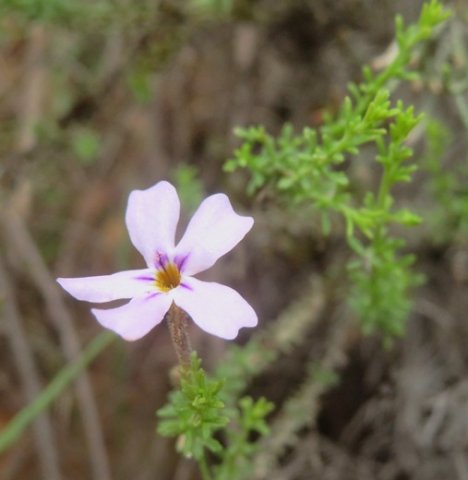
Jamesbrittenia tenuifolia flower
Author: Ivan Lätti
Photographer: Francelle van Zyl
A Jamesbrittenia tenuifolia flower can be white with blue-purple markings at the petal lobe bases, a rich yellow brown colouring its throat. This colour may be evolved to interest insects, for instance motivating bees, possibly soft targets for being enticed by the colour of honey.
The five nearly equal petal lobes favour certain of their neighbours, suggesting a slightly two-lipped structure of three and two lobes each. The Jamesbrittenia genus is quite ambivalent between radially and laterally symmetrical grouping of corolla lobes. The lobes in picture are not quite flat and not equally notched at their tips.
The cylindrical corolla tube part in view at the bottom is blackish brown, sparsely covered in short, whitish hairs (Euston-Brown and Kruger, 2023; Manning, 2007; iNaturalist).