
Albums
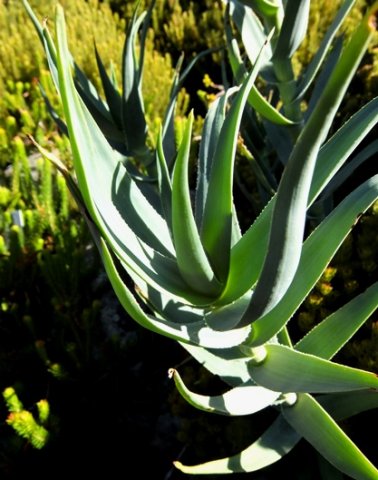
Aloiampelos tenuior leaves
Author: Ivan Lätti
Photographer: Thabo Maphisa
Aloe tenuior var. viridifolia, the green-leaf fence-aloe, used to be a rare plant of mainly the southeast coast of South Africa when the varieties of this plant were still recognised. Kirstenbosch had a sign next to a var. viridiflora plant that indicated the plants listing in Appendix II of CITES, prohibiting international trading of it without a permit. Lumping the varieties together as Aloiampelos tenuior solved the problem of rarity, although the emphasis was taken away from the less seen forms of the species.
Changes have effect. If not, nothing was changed. So, when people manage nature, they change something. Is that good? Who says, who votes on that? Society appoints responsible people to do various tasks. Their successes are the changes we live with in every field. Until we vote again. Now who are we? See, this gets one into politics.
At least six subspecies of this profusely flowering Aloe, now Aloiampelos, are mentioned in the old literature. The List of Southern African Succulents of 1997 recognises none of them.
A. tenuior also grows in Suurberg shale fynbos near the Addo Elephant National Park. There are yellow and red flowering forms.
Tiny white teeth are visible upon the margins of the glaucous, tapering leaves in the photo, spaced with diminishing internodes towards the stem tip. The variously curving leaves are long, narrow and succulent, the upper surfaces concave, the lower ones convex (Van Wyk and Smith, 2003; iNaturalist; Wikipedia).