
Albums
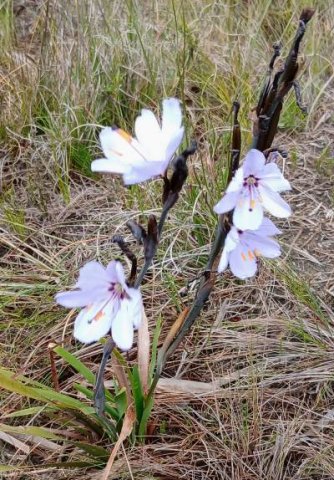
Aristea spiralis flowers
Author: Ivan Lätti
Photographer: Wikus Riekert
Aristea spiralis flowers grow in small, stalkless clusters, spaced and facing outwards from the winged, flattened stems. Each flower is subtended by large green or brown spathes with papery, transparent margins.
The flowers are white and pale to deep blue. They have small, dark purple markings around yellow or white in the corolla centres. Flowers are often notable around dusk. The corollas are large, up to 3 cm in diameter. The long, erect stamens end in narrowly oblong, orange to yellow anthers, and the long style in three fringed branches, the stigma lobes. Flowering happens from spring to early summer, mostly after fire. A flower lasts only about a day but the inflorescence may have open flowers over a protracted blooming period.
The specific name, spiralis, is derived from the Latin words spira meaning a spiral, a coil or a twist and spiralis meaning spiralled, coiled or twisted. It is unclear whether this spiralling refers to the (possibly drying) flowers or leaves.
Nectar is produced in these flowers, the only Aristea species with nectaries at its petal bases. The flowers are pollinated by horseflies with long proboscises, insects belonging to the Philoliche genus. The central floral markings may be construed to be nectar guides.
The fruits are long and cylindrical (Marais, (Ed.), 2017; Vlok and Schutte-Vlok, 2015; Manning, 2007; Bean and Johns, 2005; Bond and Goldblatt, 1984; iNaturalist; https://pza.sanbi.org).