
Albums
Agapanthus africanus
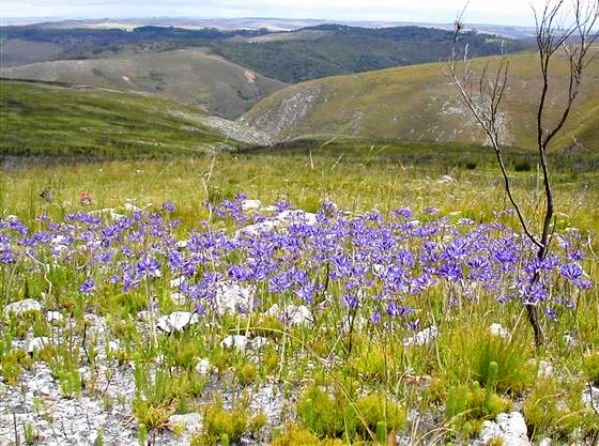
Author: Ivan Lätti
Photographer: Hildegard Crous
Agapanthus africanus, commonly known as the African lily or the Cape agapanthus, in Afrikaans as the bloulelie (blue lily) and previously as A. minor and A. umbellatus at different times in botanical parlance, is a rhizomatous perennial reaching heights from 25 cm to 70 cm. This plant was the first of its genus to be introduced to the European horticultural community by formal description in 1679.
The species distribution is in the Western Cape, from the Cape Peninsula eastwards as far as Swellendam.
The habitat is winter rainfall fynbos on rocky, sandstone mountains near the southern coast, cool places in acid soil. The plants flower well after fynbos fires, surviving fires comparatively easily due to the fleshy, underground core at the plant base and root system. The habitat population is deemed of least concern early in the twenty first century.
A. walshii bearing pendulous flowers and growing in the Kogelberg region used to be a subspecies of A. africanus. It is now a species in its own right, while A. africanus no longer has recognised subspecies.
A. africanus does not survive freezing temperatures. It is said to be difficult to cultivate, unlike A. praecox, the more well-known relative. A. praecox is the common garden plant that yielded so many horticultural cultivars (Manning, 2009; Bean and Johns, 2005; iNaturalist; www.plantzafrica.com; http://redlist.sanbi.org).