
Albums
Carissa spinarum
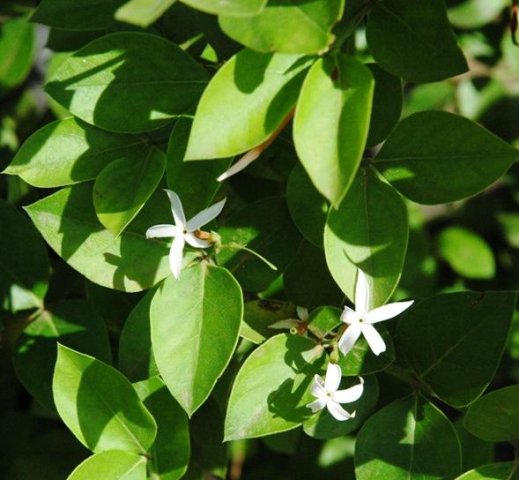
Author: Ivan Lätti
Photographer: Johan Wentzel
Carissa spinarum, commonly the climbing num-num, the simple spine carissa, sometimes the bush plum, in Afrikaans the ranknoemnoem (twining num-num) and previously scientifically C. edulis, is a multistemmed climber, an evergreen shrub and sometimes a small tree reaching heights from 2 m to 6 m (SA Tree List No. 640.4).
The leaves are ovate or ovate-elliptic, sometimes almost round, often with acute tips as in picture, and sometimes bristle-tipped. The leaf texture is leathery. The blades may be hairy, their lower surfaces paler in colour than the uppers.
The white flowers are sometimes tinged purple, although this is not evident here. The star-shaped white flowers have spreading, pointed petal lobes may spread, spiral or recurve. A bit of all three options are visible in the photo.
The fruits are spherical, slightly over 1 cm in diameter and purple to black in colour. They hold two or three seeds and ripen in summer.
The species distribution is in the far northeast of South Africa, in Mpumalanga and Limpopo, also widespread in tropical Africa.
The plant is a popular garden subject that survives moderate frost. The earlier scientific specific epithet, edulis, is a Latin word meaning edible, indicating that the fruits are edible. They are sweet and juicy, used in making jelly and jam. The roots feature in traditional medicine (Pooley, et al, 2025; Coates Palgrave, 2002; Van Wyk and Van Wyk, 1997; iNaturalist; http://redlist.sanbi.org).