
Albums
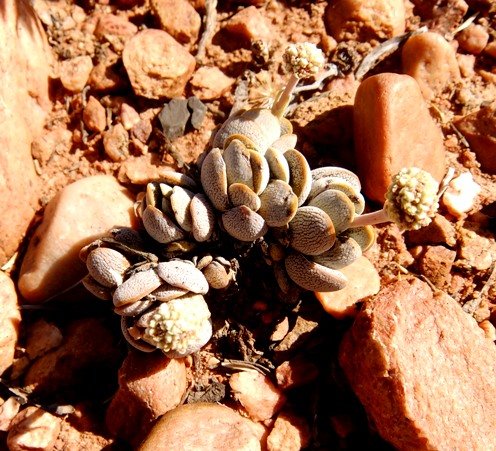
Crassula tecta leaf papillae
Author: Ivan Lätti
Photographer: Thabo Maphisa
The protective leaf papillae that shield Crassula tecta plants from heat and full sun glare are white and tiny. "Lizard skin" densely covers the leaf surfaces, here roughly arranged in vertical columns on the blades. The leaf tips, slightly pointy, don’t have papillae, but hard, orange yellow ridges.
The leaves in picture favour orange brown over the often-seen whitish grey, with hints of green between the papillae. The plant's stress may be relieved by rain. This will allow faster growth than what the plant can achieve while its leaves are coloured thus. Every season elicits the appropriate strategy for prevailing conditions.
Leaf clusters are not roundly rosette-shaped, also not quite distichous, but decussate. Equal pairs grow from stem-tips, facing each other, half in erect, close-knit positions, and at a right angle to the previous pair.
Ongoing plant design responds in evolutionary terms to climatic and other environmental changes and challenges. To the outsider, these countless micro-world adaptations appear like creative survival magic. Once one is in the habit of watching nature's problem solving methodologies, one can't stop looking (Euston-Brown and Kruger, 2023; Vlok and Schutte-Vlok, 2015; iNaturalist).