
Albums
Microloma tenuifolium
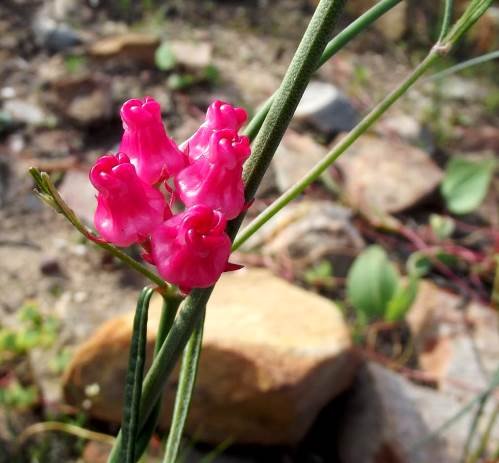
Author: Ivan Lätti
Photographer: Louis Jordaan
Microloma tenuifolium, commonly the wax creeper and in Afrikaans kannetjies (little cans), is a slender climber. It grows from thickened roots, reaching heights around 1 m.
The simple, opposite leaves are very narrow, strap-shaped to linear and channelled. They droop from near the base as in the photo. The upper surface is dark green, the midrib sunken and the margins rolled under. The lower surface is paler, whitish hairy in picture, the midrib prominent. Leaf dimensions are up to 5 cm long and less than 5 mm wide. The specific name, tenuifolium, is derived from the Latin words tenuis meaning slender and folium meaning leaf, referring to the narrow leaf-shape.
The urn-shaped flowers composed of wavy petals grow in small, often tightly compact clusters of about 2 cm wide from leaf axils, the pedicels and calyces hairy. The flowers are red, orange or pink and waxy, 10 mm to 15 mm long. The shiny petals are spirally twisted clockwise around the corolla mouth, one side of each petal inside the tube, the other out. This is a feature of many Hermannia species. Flowering happens in winter and spring.
The fruit is a spindle-shaped follicle.
The species distribution is in the Western Cape from the Gifberg to the Cape Peninsula and through the Little Karoo and along the coast to the Eastern Cape as far as Gqeberha. The photo was taken in the Outeniqua Mountain foothills south of Oudtshoorn.
The habitat is fynbos, renosterveld and scrub on stony, loamy or sandy slopes. The habitat population is deemed of least concern early in the twenty first century (Euston-Brown and Kruger, 2023; Curtis-Scott, et al, 2020; Vlok and Schutte-Vlok, 2015; Bond and Goldblatt, 1984; iNaturalist; http://redlist.sanbi.org).