
Albums
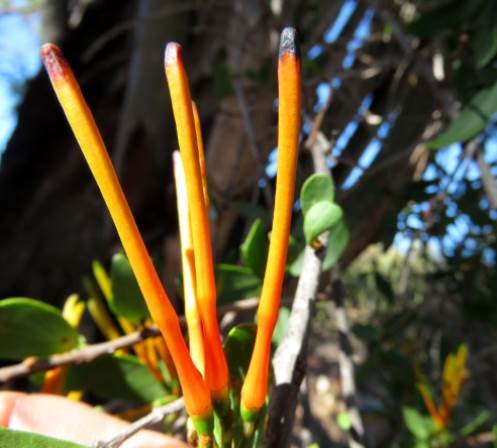
Moquiniella rubra orange tubes
Author: Ivan Lätti
Photographer: Louis Jordaan
The flowers in this Moquiniella rubra umbel are still closed but already black or blackening at their tips, prepared for anthesis. Pollinators are usually sprayed with pollen during the explosive parting of petals at opening. This is when the anthers usually break off, an event which cannot be too far into the future here. The recipient of the spraying is often a sunbird, its beak equipped for accessing tubular flowers, although events unfold surprisingly here.
Because the presence of a pollinator isn’t guaranteed at the critical moment, the plant is many-flowered, like people who buy many lottery tickets. If these plants hadn’t been “sufficiently flowered” over the years, the photo would neither have been taken, nor the plants seen anymore.
Such is the simultaneously robust and delicate nature of survival chances of so many living things on earth: strong as long as the critical variable values remain in the functional intervals for supporting life. And every species has its own set of coping requirements, the difference between being extant and extinct.
Veld life may appear a straight forward affair, but even slight changes in ecological patterns are accompanied by imminent danger for specimens, less so for species. Only a small percentage of all species that ever lived is still extant today. They all have their struggles, the outcomes never guaranteed. Short term vigour and good times adaptation create longevity sufficient for reproduction in many species, until some critical variable changes. Immortality illusions probably only develop in some people, unknown elsewhere in nature, apart from the drive to avoid immediate death shared by almost all.
The M. rubra flower colour and tube shape change visibly about one quarter up from the corolla bases. This may indicate the point where the filament bases of the stamens are attached to the inside walls of the tubes (Vlok and Schutte-Vlok, 2015; Coates Palgrave, 2002; Leistner, (Ed.), 2000; iNaturalist).