
Albums
Oscularia cedarbergensis
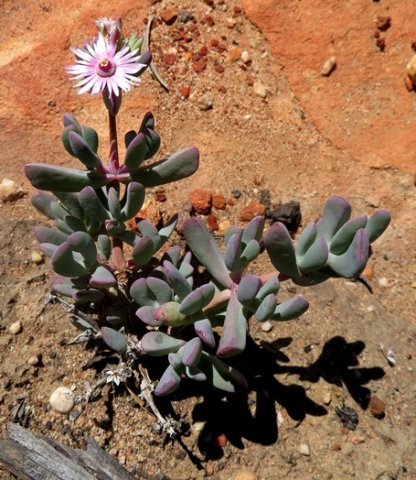
Author: Ivan Lätti
Photographer: Thabo Maphisa
Oscularia cedarbergensis, previously Lampranthus cedarbergensis and in Afrikaans commonly vyebos (figs bush), is a sprawling to rounded shrublet reaching heights around 30 cm.
The thickly succulent leaves grow in opposite pairs that succeed each other at right angles to those above and below, making them decussate. The leaf-pairs spread or curve in slightly, together at the base but not fused. The internodes vary in length, leaving some buff, pale brown or reddish stem parts visible.
The leaves are slightly sickle-shaped and triangular in cross-section (trigonous), the keels deeper than the width of the flat upper surfaces. The leaf-tip is bluntly pointed to rounded along the keel and sometimes reddish. The blades are blue-grey, covered by a waxy layer.
The species distribution is in the northwest of the Western Cape from Clanwilliam and Wupperthal southwards to south of Citrusdal. The photo was taken east of Clanwilliam.
The habitat is rocky and semi-arid, the plants growing in the open in sandstone derived soils. The habitat population is deemed of least concern early in the twenty first century (Smith, et al, 1998; iNaturalist; https://www.randomharvest.co.za; https://redlist.sanbi.org).