
Albums
Moraea villosa subsp. elandsmontana
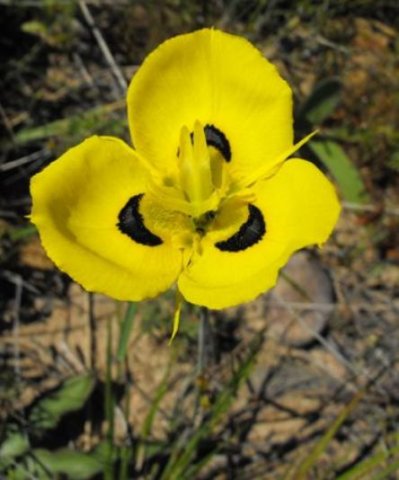
Author: Ivan Lätti
Photographer: Jonathan Honeyborne
Moraea villosa subsp. elandsmontana, commonly the peacock moraea and sometimes the Elandsberg peacock flappie, is a cormous perennial with soft, hairy stem reaching heights to 40 cm. The subspecies was only discovered in 1979 by the botanist artist Fay Anderson.
Only one narrow, hairy leaf is grown annually. The specific name, villosa, is a Latin word meaning hairy or shaggy, referring to the hairiness of the narrow leaf and the flower stem.
The subspecies distribution is small in the southwest of the Western Cape, low down on the Elandskloof Mountains. This yellow flowering form was photographed at the (nearly) eponymous site, the Elandsberg Private Nature Reserve.
The habitat is fynbos and renosterveld in stony granite and clay soils and flats. The habitat population is deemed vulnerable early in the twenty first century, due to extensive habitat loss from farming. Only one known renosterveld site remains where the plants still blooms in the wild. This Swartland population, assiduously protected in the Elandsberg Private Nature Reserve, is too small for sustaining the pollinator beetles, causing plant numbers to keep dwindling (Manning, 2009; iNaturalist; www.plantzafrica.com; http://redlist.sanbi.org).