
Albums
Pterygodium schelpei
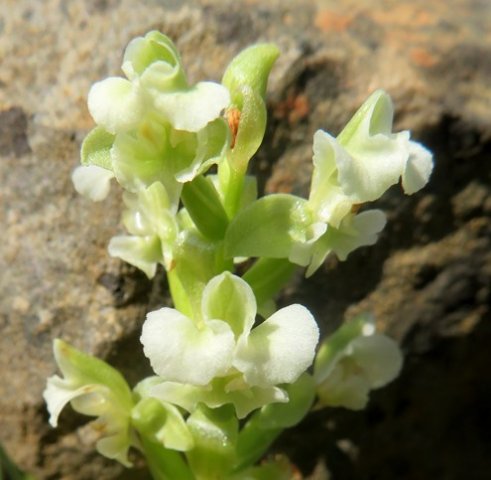
Author: Ivan Lätti
Photographer: Thabo Maphisa
Pterygodium schelpei is a slender, tuberous perennial reaching heights from 9 cm to 30 cm. The species was first described in 1988 by Linder, before that thought to be part of P. volucris.
Two or three strap-shaped to narrowly ovate leaves are grown, the basal one bigger than those up the stem. The leaf tips are pointed, acutely on the stem leaves. A leaf can be up to 15 cm long and 4 cm wide.
The loose flower spike consists of from eight to fifteen flowers, the narrowly ovate and pointed bracts deflexed below the open ones. The sepals are green, the petals and lip white or greenish white. The median sepal is positioned between the two lateral, spreading petals that are two-lobed and axe-shaped, folded with the sepal into a tube. The pendent lip is three-lobed and T-shaped, its central lobe triangular, the lateral lobes wing-like and fan-shaped with scalloped edges. The flower is up to 10 mm long and 12 mm wide.
Bloomtime is mostly spring to after midspring, sometimes starting in late winter. The flowering is not fire-dependent.
The species distribution is inland mostly in the Western Cape, from Worcester northwards, less common in the Namaqualand parts of the Northern Cape but as far as the Rosyntjiesberg in the Richtersveld. The photo was taken in the Biedouw Valley during September.
The habitat is rocky and sandy, clayey or granitic slopes covered in dry fynbos, renosterveld or karoid scrub. The habitat population is deemed of least concern early in the twenty first century (Liltved and Johnson, 2012; iNaturalist; http://redlist.sanbi.org).