
Albums
Pterygodium alatum
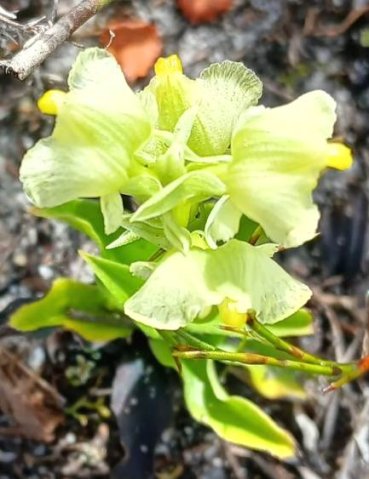
Author: Ivan Lätti
Photographer: Wikus Riekert
Pterygodium alatum, commonly known as the monkshood orchid, sometimes as the wing bonnet, in Afrikaans as vlerkies (little wings), and scientifically previously as Ophrys alata, is a tuberous perennial reaching heights in its annual above-ground parts from 15 cm to 20 cm.
Its numerous leaves are narrowly elliptic, clustered at the base and up the stem, clasping it. Sometimes glossy, the blades are shallowly channelled above and variably but acutely tipped.
The densely flowered inflorescence is a spike bearing two to many pale greenish-yellow flowers. The bracts are ovate, acutely tipped and reflexed, but somewhat outwards, not fully down.
The median sepal at the top of the flower is narrowly elliptic, flanked by the pair of somewhat triangular lateral petals ending in notched to scalloped outer margins. The specific name, alatum, is derived from the Latin words ala meaning a wing and alatus meaning winged, referring to the shape of the lateral petals. As it happens the name of this Pterygodium species contains a tautology as Pterygodium is Greek for little-winged. The lateral petals in the photo appear translucent near their tips. The lateral sepals are spreading or reflexed, oblique in shape, their tips acute.
The lip of the flower has two large, jagged-edged, spreading lateral lobes with a tiny, pointed lobe between them, as well as a conspicuous, spoon-shaped appendage. In the photo this lip appendage is thickened and brightly coloured. It is seen protruding from below the dorsal sepal of each flower, flanked by the lateral petal pair. The lip appendage serves to guide the pollinator to the column where the male and female floral parts are positioned. And that is exactly where the nectar source is waiting for the hungry pollination service provider. The species is probably pollinated by insects, bees and others with short tongues.
Bloomtime is late winter until after midspring. Colonies of hundreds, possibly thousands of these may flower after fire, as recorded for instance on Paarl Mountain.
The species distribution is in the Western Cape, from the Cape Peninsula northwards to the south of the Northern Cape around Nieuwoudtville, and eastwards coastally and through the Little Karoo to the west of the Eastern Cape as far as Humansdorp. The photo was taken on the Tolbos farm in the Hemel en Aarde Valley near Hermanus during September.
The habitat is fynbos and renosterveld on sandy and clayey flats and slopes. The habitat population is deemed of least concern early in the twenty first century (Curtis-Scott, et al, 2020; Liltved and Johnson, 2012; Bond and Goldblatt, 1984; iNaturalist; http://redlist.sanbi.org).