
Albums
Protea compacta erect staminodes
Author: Ivan Lätti
Photographer: Uri Mitrani
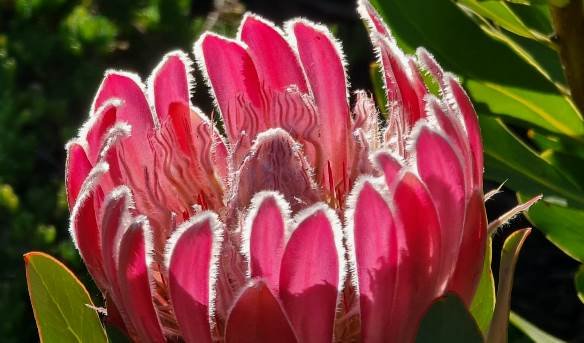
This flowerhead of Protea compacta shows densely ciliate margins of the tallest, innermost ring of involucral bracts that curve their tips in over the florets they once protected. In the centre of the head there is a compact cone of cohering not yet open floret tips waiting their turn.
Around them what remains upright of open florets is visible. In most Protea species it is only the styles tipped with pollen presenters, later stigmas, that remain erect. The photo shows that in P. compacta there is more. Two distinct types of these remaining erect floret parts are easily separated. Firstly, the expected straight styles with pollen presenters are the conventional ones in view. Secondly, what is also erect here, and not common in Protea flowerheads, are staminodes. These are outer perianth segments with no anthers at their tips, therefore not stamens but staminodes.
The outer or abaxial, fourth segment of each P. compacta floret, already opened and never carrying pollen, is a staminode, kinky and curved as a contortionist dancer who found like-minded partners. The other three pollen-delivering anther segments of each open floret have collapsed as usual when their jobs were done, although the timing of that may vary. After pollen has been delivered onto the pollen presenter, it waits for pollinators to fetch the grains and transport them to floret stigmas elsewhere.
The fourth segment, the outer one, was never burdened by such a load to deliver. Not all proteas are built like this, but P. compacta is one of the few species with a perianth segment that does not bear pollen. The staminode somehow succeeds in remaining erect, like an observer of subsequent proceedings in the head. But what could the purpose of that be? And its shape is not straight as the styles with pollen presenters, but bent and curved in its upper part into a particular shape matched by its many counterparts. Check the squiggle-heads out in the photo!
The only worrying thing in this interpretation is that there are or appear to be too many of these would-be staminodes, not equal to the number of free styles seen in the head, or one segment standing per style. So, could more perianth segments of open flowers, proper stamens, have remained erect? Or are some segments freed from still-to-open florets in the central cone of floret buds? Do the segments for some reason break apart longitudinally in maintaining their unusual posture or because of it? Or become thinner when perianths split?
A few other Protea species also have staminodes in their abaxial perianth segments. P. repens, P. longifolia and P. neriifolia are known for this, but only in P. neriifolia there is a a clear tendency of some staminodes remaining erect for some period after floret opening. Only P. compacta has such a strong showing of this unusual phenomenon (Rourke, 1980; iNaturalist; with assistance from AI tools (Copilot)).