
Albums
Psychotria
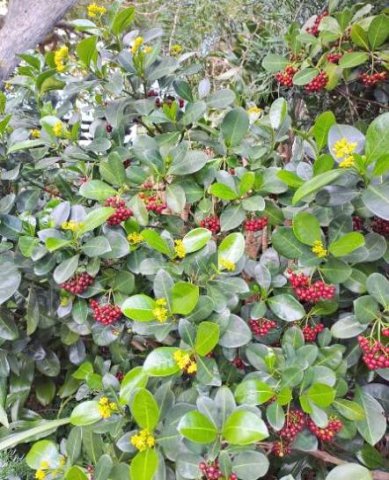
Author: Ivan Lätti
Photographer: Francelle van Zyl
Psychotria is a genus of shrubs and small trees in the Rubiaceae or coffee family.
The simple leaves are opposite, sometimes whorled, and have petioles. The leaf-shape is elliptic or lanceolate to obovate, the margins entire. The lanceolate or ovate stipules are forked or toothed, dropping off early. Colleters are present. They are multicellular secretory hairs often growing in tufts near the base of petioles, on stipules, and on sepals of plants of the Rubiaceae and another family.
The bisexual flowers grow in panicles or stem-tip cymes, some with pedicels. The small, hairless calyces persist, their tubes saucer- or cup-shaped with marginal teeth. The white, greenish or yellow corollas are hairless, ending in five reflexed lobes, shorter than the cylindrical or funnel-shaped corolla tubes. The tubes are cylindrical to bell-shaped and hairy at the throat. The five stamens arise in the middle of the corolla tubes and are slightly exserted, their filaments as long as the anthers. The anthers are oblong and may be hairy. The inferior ovaries are two-locular with one ovule per locule. The thread-like style varies in length, the stigma having two linear lobes.
The fleshy fruit is an ovoid to nearly round drupe with a ring round the top and containing one or two fruitstones. The seeds are reddish brown.
There are more than 1600 Psychotria species in tropical regions worldwide, only two occurring in southern Africa. Some of the species are endangered due to deforestation in Africa and the Pacific region. Some species yield hallucinogenic drugs.
The plant in picture is Psychotria capensis subsp. capensis (Leistner, (Ed.), 2000; Coates Palgrave, 2002; Wikipedia).