
Albums
Serruria rubricaulis
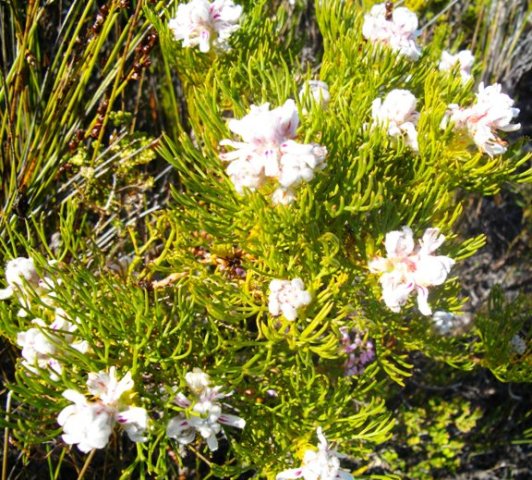
Author: Ivan Lätti
Photographer: Thabo Maphisa
Serruria rubricaulis, commonly the red leg spiderhead or the red-stem spiderhead, is a rounded to sprawling shrublet resprouting from a persistent rootstock, and reaching heights around 30 cm. The plant is characterised by redness of its stems. The specific name, rubricaulis, is derived from the Latin words rubere meaning to be red and caulis meaning stem, referring to the same feature as the common names. This is a long-lived species, its generation length from 50 to 100 years.
The leaves are dissected into thin, variably green, thread-like parts, about 12 to 18 of them, pointing upwards.
The curved buds start off in small, densely clustered flowerheads at stem-tips. Each scentless head consists of six to ten pink, bisexual florets covered in short, silky white hairs, resulting in a mophead appearance. The blooming season is late winter to early summer. Pollination is done by insects.
The fruits are released about two months after flowering. The seeds are distributed by indigenous ants that carry them off to their underground nests for eating the non-vital parts. This serves in seed dispersal, and protecting the seeds from fire.
The species distribution is in the southwest of the Western Cape, from Gordon's Bay and Hangklip to the Klein River Mountains.
The habitat is fynbos on lower sandstone slopes and flats. The habitat population is deemed vulnerable early in the twenty first century, due to habitat loss and invasive, exotic ant species that are displacing the native ant species.
The plant resembles S. adscendens, a reseeder (Bean and Johns, 2005; Bean and Burman, 1985; Bond and Goldblatt, 1984; Andrew, 2017; iNaturalist; Wikipedia; www.fernkloof.com; www.protea.worldonline.co.za; http://redlist.sanbi.org).