
Albums
Sansevieria
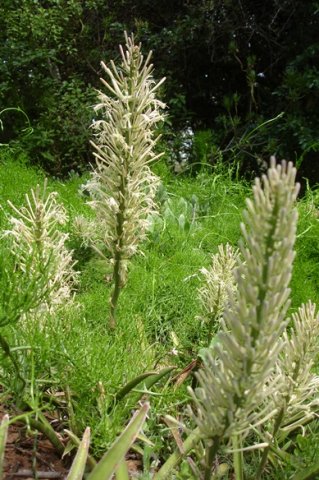
Author: Ivan Lätti
Photographer: Judd Kirkel Welwitch
Sansevieria is a genus of stemless perennials commonly known as mother-in-law’s tongue and sometimes as bedroom plants. The genus forms part of the Asparagaceae family after latest studies and reclassifications and Sansevieria is now regarded internationally as part of the Dracaena genus. At the time of writing SANBI still retains Sansevieria as a distinct genus and lists it under Ruscaceae in the Red List.
Sansevieria plants are strongly rhizomatous, drought-hardy and forming colonies. The thick, cylindrical rhizomes are fibrous and articulated, some creeping, bearing thin cataphylls that clasp and drop off early. The roots are positioned near the aerial shoots.
The one to many, stalkless leaves grow in basal rosettes or fans and flat, cylindrical or between these two shapes, some with a groove on top. The blades are plain or covered in irregular, transverse lighter and darker bands. Young leaves may differ.
The inflorescences are between spikes and racemes, as the flowers are nearly stalkless. The flowers are scented, growing in irregular clusters, opening haphazardly higher up and lower down on the scapes near evening, each lasting for one night only. The buds are long and narrowly cylindrical, the six tepals of a flower in two concentric whorls.
They recurve dramatically at anthesis, that means when the flowers open. In this action the stamens are exserted far. The thread-like filaments are fused in a tube near the base lending stability. The superior ovaries are ovoid in shape, tipped with long, thread-like styles that are exserted early, already from the long, closed buds.
The fruits are berries with smooth or tuberculate surfaces. The seeds are bony, covered in thick skins.
There are about sixty Sansevieria species, mostly in tropical Africa and Asia. At least six species occur in southern Africa, none in nature in the Western Cape.
Some sansevierias, such as Sansevieria trifasciata have been proven capable of purifying air by removing certain pollutants, using the crassulacean acid metabolism process or CAM photosynthesis. Carbon dioxide is absorbed at night by the Sansevieria leaves, releasing oxygen during daytime. Temperature, carbon concentration, pH levels or light and dark reactions have been found not affect the rate of photosynthesis in some Sansevieria species. The nighttime carbon dioxide absorption thus makes them suitable bedroom plants. Since these leaves may be poisonous when ingested, they are mostly not used in children's bedrooms. Some of these plants cope with limited daylight. There are other plant species also use the CAM process, such as Bryophyllum.
S. trifasciata, a West African species, is ironically also deemed an invader in South Africa, in the north of KwaZulu-Natal, listed by SAPIA, the Southern African Plant Invaders Atlas.
Sansevierias are widely used in horticulture, also in containers and indoors. The plant in picture is thought to be Sansevieria concinna (Leistner, (Ed.), 2000; Pooley, 1998; Wikipedia; https://www.arc.agric.za; https://www.globalscientificjournal.com; https://scholarship.claremont.edu).