
Albums
Strelitzia juncea
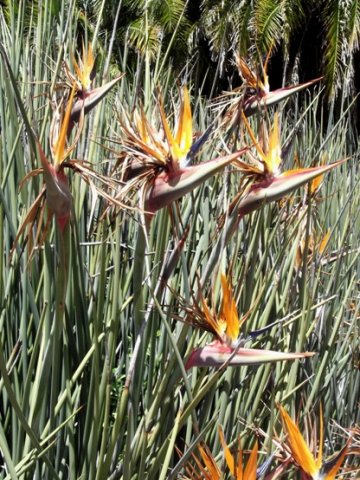
Author: Ivan Lätti
Photographer: Ivan Lätti
Strelitzia juncea, commonly called the rush-leaved crane flower, and previously scientifically S. parvifolia var. juncea, is an evergreen perennial reaching heights beyond 1,5 m and spreading as widely. The monocot herb grows a rush-like tuft of many stems from a mass of fleshy roots. The earlier parvifolia name recognises the small leaves sometimes seen, parvus meaning small in Latin. Otherwise the plant resembles S. reginae in growth habit.
The stiff, straight and leafless stems represent the defining characteristic of the species. Poker-like and cylindrical, without leaf blades or merely tiny, narrow ones, always much reduced and on young plants, only the bare stems remain on mature plants. These stems serve well as leaf substitutes in photosynthesis, rendering leaf blades redundant.
The species distribution is small and coastal in the Eastern Cape, from Humansdorp to Kariega (Uitenhage). The photo was taken in November in the Caledon Wildflower Garden.
The habitat is thicket, semi-arid scrubland and dry riverine slopes where succulents are common. The habitat population is deemed vulnerable early in the twenty first century, due to illegal plant collection, quarrying, habitat degradation, and invasive alien vegetation (Bond and Goldblatt, 1984; Eliovson, 1984; iNaturalist; https://pza.sanbi.org; https://redlist.sanbi.org).