
Thesium euphorbioides
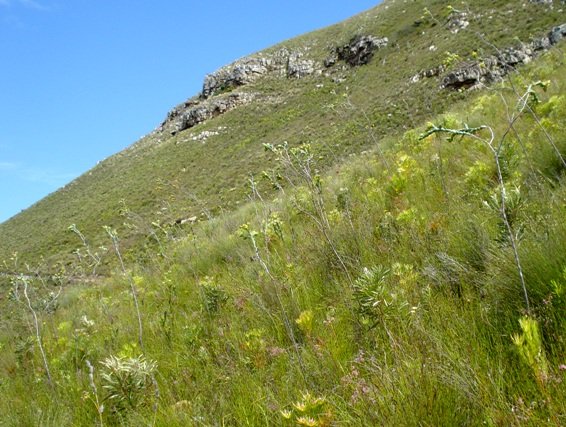
Author: Ivan Lätti
Photographer: Judd Kirkel Welwitch
Thesium euphorbioides is a slender, single-stemmed, broad-leaved shrub that reaches 2 m in height. The plant is a hemiparasite, partially parasitic upon the roots of neighbouring plants.
The species distribution is near the southern coast of the Western Cape, from the Cape Peninsula to the Eastern Cape as far as Kariega (Uitenhage).
The habitat is rocky fynbos slopes. The habitat population is deemed of least concern early in the twenty first century.
These tall plants in the photo tower over young fynbos next to a Fernkloof Nature Reserve path. Although the plants are single-stemmed, their parasitic dependence upon host plants is probably allowing them to resprout, getting early head-start over the reseeder plants around them. That may mean they had picked other resprouters for support, or would have died with their hosts in the fire. It may also be that tall hemiparasites photosynthesise better, thus becoming less dependent upon their hosts and enabling them to grow fast (Vlok and Schutte-Vlok, 2015; Manning, 2007; Bean and Johns, 2005; Bond and Goldblatt, 1984; iNaturalist; http://redlist.sanbi.org).