
Albums
Thamnochortus
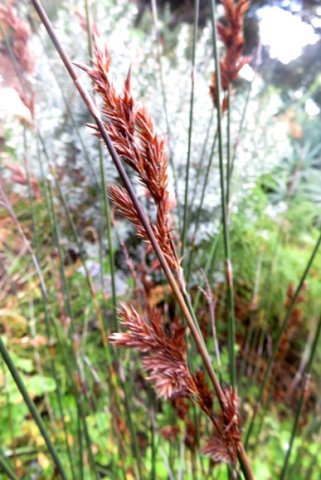
Author: Ivan Lätti
Photographer: Thabo Maphisa
Thamnochortus is a genus of densely tufted, perennial plants that grow numerous, thin stems. Their family is the Restionaceae or commonly the restios. The tufts or tussocks are sometimes tall and slender, the rhizomes in the ground sometimes short but often well developed.
The jointed, mostly simple and unbranched culms are solid, never hollow as those of grasses. Thamnochortus culms grow persistent leaf sheaths from their nodes. These sheaths are longitudinally rolled upon themselves, often ragged or torn in their upper parts. A culm also often grows a cluster of sterile shoots from its nodes in the year after it flowers. Although a culm flowers only once, the plant expands by growing new culms every year. The culms are green, performing the photosynthesis function of the plant in the absence of leaves.
Male and female flowers grow on different plants, the genus dioecious. Male plants bear many, pendulous, cylindrical to oblong spikelets, slender with dry, papery bracts. The spikelets, the plant’s florets, each comprises a six-segmented perianth, the outer lateral segments boat-shaped and keeled, longer than the inner ones. The anthers are exserted from the open florets.
The female inflorescence, appearing different from the male one, consists of one to several larger, stiffly erect spikelets, the spathes usually small. Each female spikelet has cartilaginous bracts, and six persistent cartilaginous segments, the outer ones keeled or winged. The ovary has one locule and a single, densely brush-like style, exserted from the bracts when the floret is open. The open anthers and style at anthesis are related to the wind pollination the genus depends upon.
In the similar genus, Staberoha, the styles are never single in the spikelets.
Thamnochortus fruits are soft-walled nutlets.
There are about 33 Thamnochortus species, mostly in the Western Cape, from Clanwilliam to the Eastern Cape, as far as Kariega (Uitenhage).
Thamnochortus insignis, commonly the Albertinia thatching reed, and in Afrikaans dekriet (thatching reed), is the most significant species commercially. These thatching reed plants are cut annually in winter after the growing season, just before the annual growth begins.
The plant in picture is a female T. pluristachyus (Leistner, (Ed.), 2000; Vlok and Schutte-Vlok, 2015; Dorrat-Haaksma and Linder, 2012; Manning, 2007; Van Wyk and Gericke, 2000; https://www.fernkloof.org.za).