
Albums
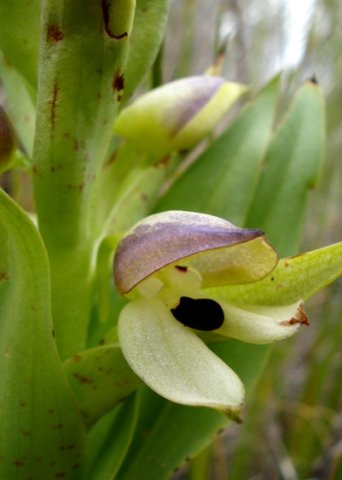
Disa cornuta flower
Author: Ivan Lätti
Photographer: Judd Kirkel Welwitch
The flowers of Disa cornuta, bringing about common names including horned disa or golden disa, grow in dense, cylindrical spikes, varying in length from 20 cm to 70 cm. The reference to gold reflects the colouring of especially the inside of the hood. Another common name for the species, inkspot disa, tells about the dark lip of the flower. This feature makes D. cornuta one of the more recognised species.
The ascending bracts subtending the flowers are acutely pointed, as tall as their corresponding flowers or slightly taller.
The conspicuous floral parts notable in the photo are the sepals. The dorsal sepal or hood is purple with gold and the lateral sepals, white and oblong, flanking the dark lip.
The conspicuous black or nearly black lip presents its obovate upper surface, velvety and rounded, near the base of the two lateral sepals. The lip is darker in flowers growing in the western parts of the plant’s distribution. The shy anther and stigma lie horizontal behind the lip, flanked by the two small white lateral petals, all well covered under the hood.
Bloomtime is mid-spring through summer in the Cape Floristic Region (Liltved and Johnson, 2012; iNaturalist).