
Albums
Harveya capensis
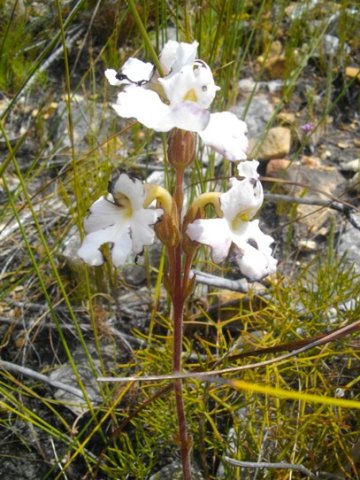
Author: Ivan Lätti
Photographer: Thabo Maphisa
Harveya capensis, in Afrikaans the witinkblom (white inkflower), is a usually slender perennial parasite that reaches heights around 40 cm. The leaves are scale-like, lacking chlorophyll, never green. The host plants are often shrubs, including Cliffortia, Erica and Searsia.
A slight pink tinge may be seen on the large, wavy, commonly white flower corollas that measure about 3 cm across. The flowers grow in loose racemes. Flowers have curved, funnel shapes with yellow throats resembling keyholes. The flower tube or funnel is narrowed on the sides and about 3 cm long.
The flowers are scented at night, suggesting moth or other nocturnal insect pollinators. There are, for instance, nocturnal flies. Flowering happens in late spring and summer.
The species distribution ranges across the southern parts of the Western Cape from the Gifberg to Gqeberha in the Eastern Cape.
The habitat is fynbos where the plants grow on lower sandstone slopes and flats. The habitat population is deemed of least concern early in the twenty first century (Vlok and Schutte-Vlok, 2015; Manning, 2007; iNaturalist; https://www.fernkloof.org.za; http://redlist.sanbi.org).