
Albums
Helichrysum
Author: Ivan Lätti
Photographer: Thabo Maphisa
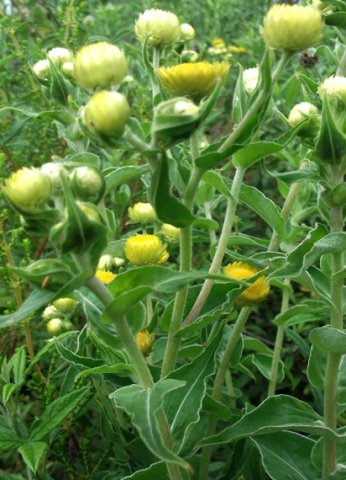
Helichrysum is a genus of annual, biennial and perennial herbs and shrublets in the Asteraceae family. The plants are often called strawflowers or everlastings, and in Afrikaans sewejaartjies (literally: little seven years, or better: everlastings, ever meaning seven). Some plants are erect, others prostate or spreading.
The alternate leaves are variously shaped, the blades flat or with rolled under and entire margins.
The flowerheads grow solitary or in flat-topped clusters at stem-tips. The peduncles vary in length and are sometimes glandular. The bell-shaped involucres consist of several rings of papery or chaffy bracts, sometimes variable between inner and outer ones. The smooth or honeycombed receptacle has no scales but may be fringed.
In the disc one or more rows of marginal florets are female and tubular around the five-lobed, bisexual ones, also tubular or funnel-shaped. A great variety of involucre and floret colours occur in the many species.
The anthers are tailed, the styles are tufted and truncated, the stigmas separated. This means that the two stigmatic surfaces on the style do not form one continuous receptive area. They are instead two distinct, separate stigmatic lobes. The fruits are smooth or hairy, the pappuses consisting of bristly hairs.
There are about 600 Helichrysum species, most of which occur in Africa, although there are some in Europe, Asia, Australia and on some islands. Southern Africa has about 244 species. They larger, older plant families may often be among the older genera.
Everlastings are widely grown as ornamental plants. Many butterfly species use them as food during the larva phase
Several species yield soft, woolly, felted or cobwebby leaf and stem material used by people as bedding when sleeping in the veld, in Afrikaans called kooigoed (bedding material). Several of the plants feature in traditional medicine and in horticulture.
The plant in picture is Helichrysum foetidum in its second and final flowering season (Leistner, (Ed.), 2000; Manning, 2007).