
Hereroa
Author: Ivan Lätti
Photographer: Judd Kirkel Welwitch
Hereroa is a genus of small, tufted perennials and shrublets up to 20 cm tall in the Aizoaceae or mesemb family. The generic name, Hereroa, is derived from the name of a tribe of Namibian indigenous people. The plants are commonly known as clock plants and in Afrikaans as slaapvygies (sleep mesembs), on account of the timing patterns in their flower opening that happens only during afternoons and evenings, when much else that sleeps is preparing for it.
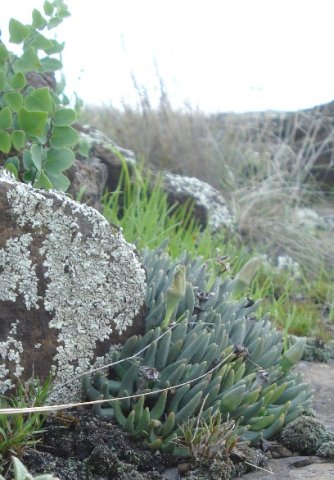
The leaves are opposite and joined at the base, finger-like with narrow to blunt tips and sometimes laterally compressed in their upper parts. Leaf colours range from bright green, dark green and purplish green to shades of grey. The leaf surfaces are hairless, covered in dark dots that are raised when the leaves lack moisture. The leaf stomata are not sunken, or only slightly.
The flowers grow solitary or in dichotomous cymes. They have longish pedicels and bracts below the flowers. Flower diameter is up to 4 cm. The fragrant flowers are mostly yellow with reddish on the outsides, or sometimes white. The five unequal, succulent sepals taper to their tips. There are two to four whorls of petals.
The numerous stamens often have papillae at the base. The nectar glands in the flower base are separate or fused into a ring. The ovaries are often concave on top, and there are five thread-like stigmas in each flower, longer than the stamens.
Bloomtime is mainly summer.
The fruit is a capsule with five locules, the placentas raised on the outer walls. There are covering membranes and small closing bodies. The expanding keels are without wings and often narrow. The light brown seeds are small, pear-shaped and concave at one end.
There are 32 Hereroa species, all growing in southern Africa.
The plant in picture is Hereroa glenensis (Leistner, (Ed.), 2000; Smith, et al, 1998).