
Albums
Hermannia holosericea
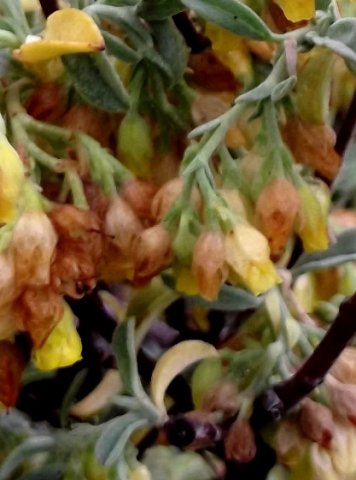
Author: Ivan Lätti
Photographer: Thabo Maphisa
Hermannia holosericea is a branching, velvety grey shrub or shrublet growing upright to heights between 30 cm and 1,2 m in height. The single-stemmed plant does not resprout after fire.
The greyish leaves have a dense covering of fine, star-shaped hairs. The specific name, holosericea, is derived from the Latin prefix holo- meaning entire and the Latin word sericea meaning silky, referring to the hair covering on leaves and other plant parts. The blades are ovate, tapering to acute tips and fold in along their midribs. Leaves may be toothed in their upper parts. Leaf size is about 2 cm by 1 cm.
Small yellow flowers are borne from autumn to early spring in branched inflorescences. A hairy, pointed calyx overlaps about half of the corolla in the pendulous flower. Bees frequent the flowers.
The species is found along the Western Cape coast from Bredasdorp to Mossel Bay, the Little Karoo and westerly parts of the Eastern Cape, as far as Kariega (Uitenhage).
The plants grow on slopes and flats in renosterveld and karoid scrub in coastal limestone and clayey soils. The habitat population is deemed of least concern early in the twenty first century (Euston-Brown and Kruger, 2023; Curtis-Scott, et al, 2020; Vlok and Schutte-Vlok, 2015; Bond and Goldblatt, 1984; iNaturalist; http://redlist.sanbi.org).