
Albums
Dasispermum suffruticosum
Author: Ivan Lätti
Photographer: Ivan Lätti
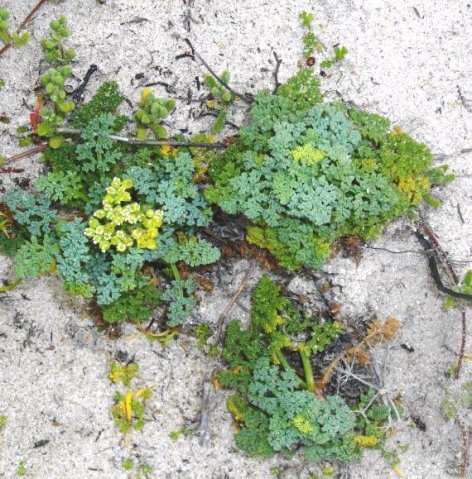
Dasispermum suffruticosum is a sprawling perennial growing from a woody base, occasionally to heights around 50 cm. It looks a bit like a garden herb. That brought it the Afrikaans name of duineseldery (dune celery), although it is not in the commercial league of Apium graveolens, the real celery.
The somewhat woody stem starts off erectly with a few branches, but sprouts more of them annually from the nodes on the stem, as the plant sprawls on the sand. The leaves are intricately divided, firm and slightly succulent or fleshy, with the terminal leaflet characteristically turned inwards.
Flowering may happen at any time during the year depending on weather conditions, but is least likely in autumn. Flowers occur in dense umbels of small white or cream flowers with few succulent involucral bracts. The fruit is elliptical, about 4 mm in length with prominent corky ribs or wings along its length.
The plant occurs widely along the SA coastline from the Olifants River to the Cape Peninsula to the Eastern Cape and KwaZulu-Natal as far as Port Shepstone.
The habitat is coastal dunes associated with thicket and fynbos, well described as a “dune endemic”. The habitat population is deemed of least concern early in the twenty first century.
The genus Dasispermum comprises seven species, two of which are perennials. A revision of this and related genera was published by Magee (Manning, 2007; iNaturalist; Magee, et al of UJ, 2009, in www.life.illinois.edu; http://redlist. sanbi.org).
().