
Albums
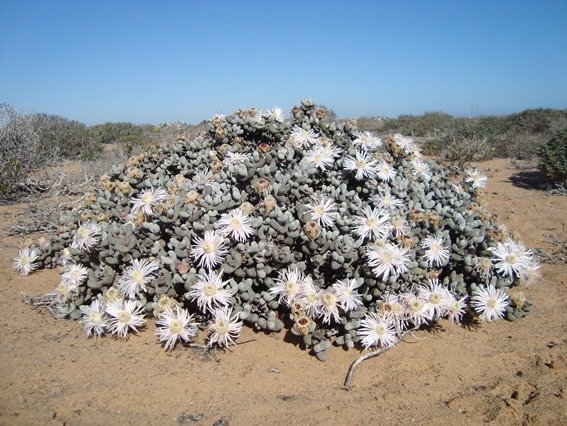
Wooleya farinosa powdered leaves!
Author: Ivan Lätti
Photographer: Judd Kirkel Welwitch
The visible leaves on an older Wooleya farinosa plant mound are more when flowering is not at its peak. Among them are both the pale grey young leaves, and the darker hues of older ones in several stages of fading contributions to plant welfare. The leaves are short, cylindrical to slightly flattened, growing in equal leaf-pairs from stem-tips, and decussate in arrangement, i.e. at 90° rotation between successive pairs.
The specific name, farinosa, is a Latin word associated with a recognisable explanatory English botanical term, farinose, meaning covered in a whitish, mealy, or flour-like powder. The word refers to leaves or plant surfaces that have a powdery coating. This dense covering or coating on young W. farinosa leaves typifies the plant, give the vygie its name.
Why the powder? Not cosmetics in human terms. It reflects the intense sunlight on the flats and dunes where the plant lives, deals with high UV, and reduces leaf temperature, rendering the plant's living conditions more bearable. Could the powder layer get heavier as global warming hits the desert? Future hotter heads may see something of this.
And the fog from the sea hovering over these plants may also be affected by the leaf powder, reducing the amount of nutrients washed out of the leaf (Cowling and Pierce, 1999; Smith, et al, 1998; Roller, 2024: Dudleya farinosa: Environmental Challenges, Human Threats, and Conservation. Cactus and Succulent Journal, 96(1), 41-48; iNaturalist; Wikipedia).