
Albums
Faucaria tuberculosa
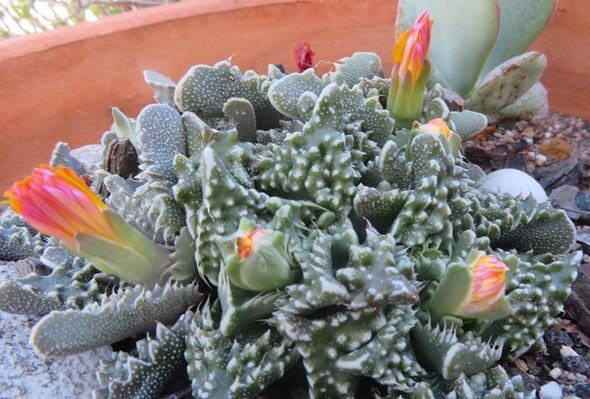
Author: Ivan Lätti
Photographer: Francelle van Zyl
Faucaria tuberculosa, commonly known as the warty tiger jaws and previously scientifically as F. felina subsp. tuberculosa, is a dwarf leaf succulent forming ground-level clumps up to 5 cm in height. The plant forms part of the mesemb family.
The leaves are thickly succulent, ovate-rhomboid or somewhat triangular, arranged in opposite pairs. The margins bear three to ten short, stout, white teeth on each side of the concave upper surface, resembling jaws as reflected in the generic name. This generic name, Faucaria, is derived from the Latin word fauces meaning throat, narrow channel or jaws of an animal, referring to the leaf appearance. A Faucaria would be a collection of jaws.
Some of the teeth end in thread-like prolongations. Numerous small white spots are often scattered upon the dark green leaf surfaces or fewer, larger, white, wart-like tubercles may be present, or both of those. The tubercles differentiate the species from F. tigrina. Leaf dimensions are 2,5 cm long and 2 cm wide.
The flowers grow solitary and sessile or short-pedicelled from stem-tips. The five unequal sepals are green and smooth in picture, contrasting against the tubercle-covered leaves. The erect bunches of orange petals in picture will spread into yellow, mesemb-like flowers soon. Open flowers are about 4 cm in diameter. The flowers open in the afternoon and close later in the day. Faucarias mostly flower late in summer or during autumn.
The species distribution is small, inland in the Eastern Cape Karoo, mainly around Fort Beaufort and Bedford.
The habitat is arid, karoid scrub. The habitat population is deemed of least concern early in the twenty first century (Leistner, (Ed.), 2000; Smith, et al, 1998; Wikipedia; https://worldofsucculents.com; https://redlist.sanbi.org).