
Albums
Carpobrotus
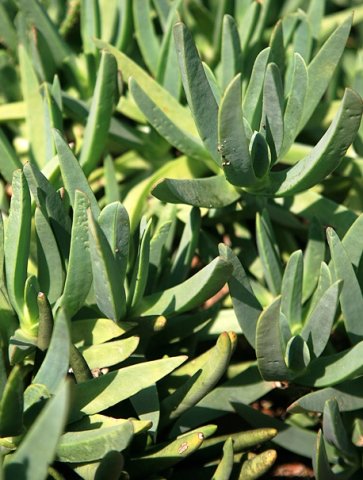
Author: Ivan Lätti
Photographer: Johannes Vogel
Carpobrotus is a genus of robust leaf succulents, trailing perennials that form large leafy mats. The genus forms part of the Aizoaceae or mesemb family, often called sour figs. The resilient stems are yellow, brown or maroon, sometimes narrowly winged or angled.
The erect leaves grow in opposite pairs, slightly fused at the base and triangular in cross-section. The smooth surfaces are green, grey green or blue green, sometimes tinged red. The margins and keels are finely cartilaginous, smooth or finely toothed. The leaves may be up to 15 cm long in some species.
The large daisy-like flowers grow solitary and stalked at stem-tips with bracts on the pedicels. Each flower-base is two-ridged, tapering into the stalk gradually or abruptly. The five sepals are equal or unequal. The yellow, pink, magenta in different shades or white flowers open in the morning sunlight and close at dusk. The petals are narrow, oblong and free, occurring in about one to a few whorls. The stamens are numerous. Nectar glands form a wavy or notched ring in the flower base. There are four to twenty feathery stigmas. The ovules grow on the inside of the outside walls of the ovary. The flowers are up to 15 cm wide. Flowering happens from spring to summer.
The fleshy, succulent fruits have four to twenty locules. The seeds are embedded in mucilage in the locules. The fruits remain closed when ripe. The generic name, Carpobrotus, is derived from the Greek words karpos meaning fruit and brotos meaning edible or fit to be eaten, referring to the fruits that are often eaten by people and animals, including baboons, klipspringers, and other antelopes.
There are thirteen Carpobrotus species in the Americas, Australia and southern Africa, seven of which occur in South Africa, often in scrubland, sandy and marshy places. Some introduced species have escaped into nature and invaded in several parts of the world.
The strong-growing plants bearing attractive leaves, flowers, and edible fruits are planted in gardens as ground covers, for preventing erosion and retaining slopes. The South African species most popular for making jam, Carpobrotus deliciosus, is commonly called gaukum, a Khoi word. There are or have been medicinal uses for the leaf sap (Leistner, (Ed.), 2000; Vlok and Schutte-Vlok, 2015; Manning, 2009; Van Wyk and Gericke, 2000; Smith, et al, 1998; Wikipedia).