
Albums
Wooleya farinosa
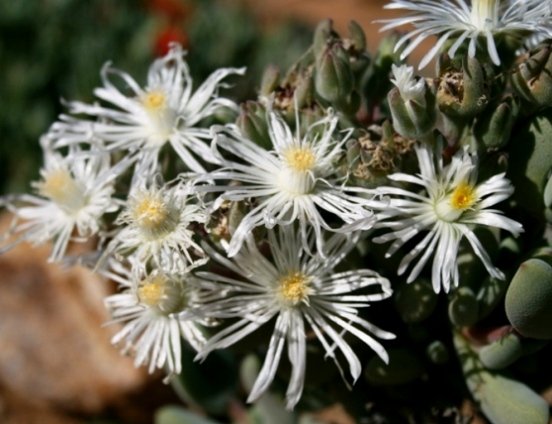
Author: Ivan Lätti
Photographer: Alet Steyn
Wooleya farinosa, previously scientifically known as Namaquanthus farinosus, is a dwarf leaf succulent, a branched and compact mesemb reaching about 20 cm in height. It is the only species in the Wooleya genus.
The Afrikaans common name of vaalvygie (grey mesemb), refers to the ash-grey leaves. Older leaves occasionally display brownish or purplish colouring. Leaves grow densely in pairs on the spreading shrublet. Leaf shape is nearly cylindrical, flattened on the inside or upper surface, rounded on the outside, lower surface.
There is an unruly petal (dis)arrangement in picture, probably age-related. White is clearly not too timid a colour for exuberance in the remote corner of Namaqualand where these plants grow.
The geographical distribution lies in the northwestern coastal part of Namaqualand, from Port Nolloth to Hondeklipbaai.
The habitat is short sandveld, coastal sand on calcrete flats and dunes within the coastal mistbelt zone. Shell grit and sea salt render the soil saline and calcium-rich. The habitat population is deemed vulnerable from mining and coastal development.
It is interesting to note that another plant, Haworthia woolleyi, named after the same person, a Major Woolley who contributed plant samples to the Kirstenbosch collection, has a different spelling of the surname in the two plant names (Cowling and Pierce, 1999; Smith, et al, 1998; iNaturalist; http://redlist.sanbi.org).