
Albums
Carpobrotus edulis subsp. edulis
Author: Ivan Lätti
Photographer: Thabo Maphisa
Carpobrotus edulis subsp. edulis, commonly known as the common sourfig and in Afrikaans as the rankvy (creeping fig), is a leaf succulent, a robust perennial that forms a dense mat of multiple trailing stems. It forms part of the Aizoaceae or mesemb family. The branching stems are up to 2 m long, rarely taller than 20 cm.
The paired, three-angled leaves are large, thickly succulent and straight or curved in slightly. The opposite leaf-pairs are erect, fused at the base. The surfaces smooth and green, the margins and keels sharp and smooth.
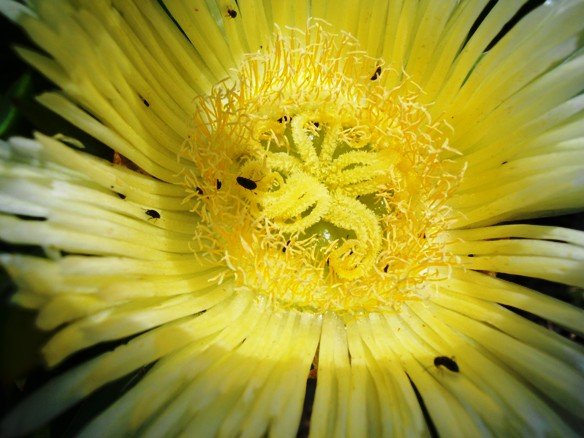
The flowers are large in mesemb terms, up to 8 cm across. They grow solitary at the branch tips. Yellow in colour, old flowers wither to slightly pink. The style and stigma are often prominent in the centre among the large cluster of stamens. The base of the calyx tapers from the five sepal lobes around the ovary to the pedicel that becomes a pulpy, segmented fruit capsule.
These plants grow along the coast in the west and south of South Africa in the west of the Northern Cape, through the Western Cape to the south of the Eastern Cape.
The habitat is varied coastal and inland sandy slopes and flats among fynbos, renosterveld and scrub. The habitat population is deemed of least concern early in the twenty first century.
The fruits are sought after, eaten by several animal species, as well as by people that also make jam of them. Medicinal uses of the leaf juices include making lotions for treating burns and bluebottle stings (Vlok and Schutte-Vlok, 2015; Manning, 2007; Mustart, et al, 1997; iNaturalist; http://pza.sanbi.org; http://redlist.sanbi.org).