
Albums
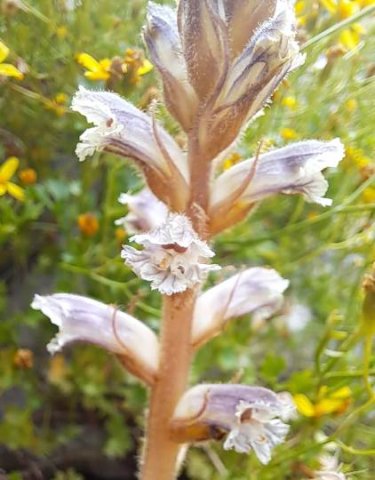
Orobanche minor flowers
Author: Ivan Lätti
Photographer: Francelle van Zyl
The bisexual flowers of Orobanche minor grow spaced in a spike. Up to 75 flowers may be produced on an unbranched stem. Each flower is subtended by a brownish bract with a calyx inside around the corolla base. The sepals or calyx lobe tips in picture are elongated conspicuously.
The tubular corollas are two-lipped, the upper lip two-lobed, the lower one three-lobed. The tubes curve down slightly, hairy on the outside, the lobes ending in toothed and wavy tips. Flower colour is variable, including red-brown, yellowish and purple. The flowers in picture are mainly white with blackish purple areas and lines nearer tip than base. The corollas tend to remain attached after withering.
The four stamens are included. The superior ovary has one locule with four placentas inside, placed away from the central axis on the outer walls (parietal). Numerous ovules are present in a locule. The thick, flattened style ends in a two-lobed stigma. Nectar is produced. The pollinators are insects, but self-pollination also occurs.
Flowering happens mainly from late winter to after midspring, sometimes slightly longer. The photo was taken in Kirstenbosch early in November.
The cylindrical fruit is a two-valved capsule, the about two thousand minute seeds from each shaken out by wind when the capsule dehisces. The embryo may only develop once contact with a host plant is established. The number of seeds and capsules per plant are reasonable precautions for the species survival, given the likelihood of one seed reaching a host plant root. Another example of nature’s bluntly functional but innumerate statistical sense (Visser, 1981; iNaturalist; Wikipedia).