
Albums
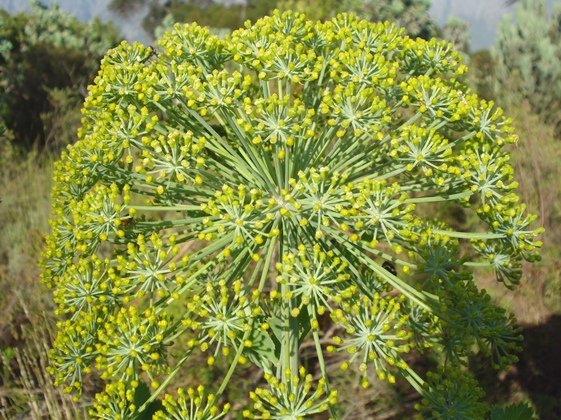
Notobubon galbanum, a study in rounded structures
Author: Ivan Lätti
Photographer: Judd Kirkel Welwitch
The numerous umbels on long peduncles that are naked and pale green inside one Notobubon galbanum inflorescence, create quite an impression. All the peduncles are just long enough for a roughly spherical effect overall. The pedicels of the smaller umbels each ends in a tiny, yellow flower. These pedicels are thinner and whiter than the peduncles of the lesser umbels, let alone the big one of the whole inflorescence. The pedicels are also sufficiently short and aligned in length to yield the smaller globes that remind of atom nuclei surrounded by clouds of electrons, or to go bigger, star systems of revolving bodies. Here it all ends in the yellow dots of individual flowers.
This is an ingenious and elaborate design for presenting flowers, and eventually for setting seed. The generalist pollination strategy followed by this plant species of inviting bees, flies, wasps, butterflies, moths and even beetles without exclusivity works well, the future of the species unthreatened.
At least one of the pollinating participants, the citrus swallowtail butterfly, scientifically Papilio demodocus, goes further. It means that this insect stays longer and lays its eggs on the plant, for its larvae to feed on the foliage later. (Clearly butterflies don't blister from these leaves like people.) The chutzpah of some visitors is hard to believe indeed, repeated generation after generation. But once there is mutualisation in benefits to participating parties there is another miracle of natural cooperation, food for pollination, ensuring the survival of at least two species (Bean and Johns, 2005; Mustart, et al, 1997; iNaturalist; http://pza.sanbi.org).