
Albums
Lippia rehmannii
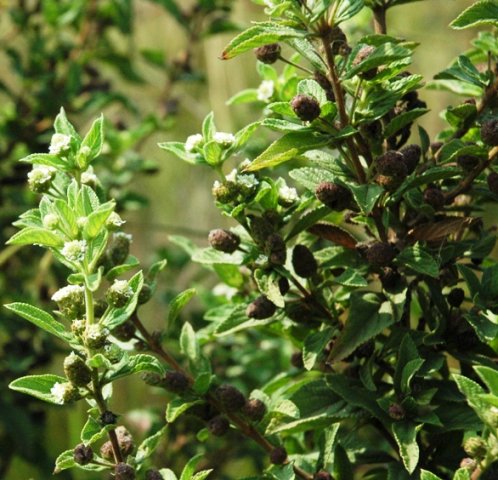
Author: Ivan Lätti
Photographer: Johan Wentzel
Lippia rehmannii, in Afrikaans commonly the Beukesbossie (little Beukes bush) and previously scientifically L. bazeiana, is an erect to spreading, woody shrublet that grows to heights around 50 cm. The young branches are square in cross-section, becoming cylindrical with age. The plant is aromatic, the fragrance resembling orange or lemon peel.
The species distribution is limited in the northeast of South Africa, only in Gauteng, mainly near Pretoria and on the Magaliesberg.
The habitat is grassland and bushveld, also in areas where the soil has been disturbed, often in sour, sandy soils. The habitat population is deemed of least concern early in the twenty first century.
The plant is quite similar to its more well known and widespread relative, L. javanica that is much used, mainly for its essential oils, and uses in herbal remedies and health teas. L. rehmannii is listed in South Africa (and internationally) as a weed. It is notorious for giving sheep that browse it a disease called geeldikkop (yellow thick head), an off-putting prospect, even for sheep.
Some lippias (there are more than 200 of them worldwide), particularly L. graveolens, not a South African plant, are used in food similarly to oregano. Lippia forms part of Verbenaceae, while Origanum is in the mint or Lamiaceae family (Van Wyk and Malan, 1997; Vahrmeijer, 1981; iNaturalist; http://bodd.cf.ac.uk; ww.hear.org; http://redlist.sanbi.org).