
Albums
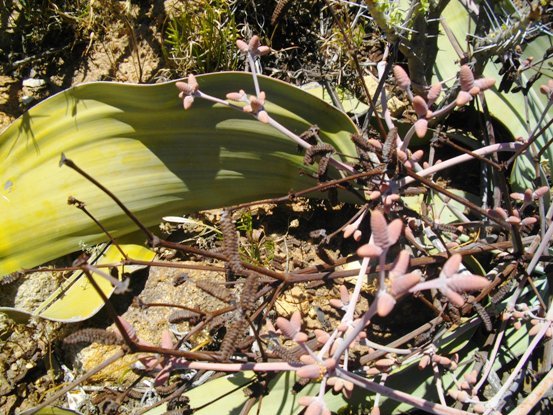
Welwitschia mirabilis male cones
Author: Ivan Lätti
Photographer: Thabo Maphisa
A mature Welwitschia mirabilis plant consists of a stem base from which two broad strap-like leaves grow directly and keep growing for as long as the plant lives, as well as some roots, including a robust taproot. The two light green or yellow green, longitudinally channelled leaves lie on the sand like discarded clothing, photosynthesizing and absorbing moisture from the dew deposited during the regular fog periods. Forces of nature, herbivores and other factors damage the leaves so that the ends break off and they only get a few metres long.
Male and female cones appear on separate plants. The male cones are salmon pink, narrow and oblong, while the wider and bigger female ones taper more. Welwitschia displays gymnosperm as well as angiosperm features, i.e. it is in-between the conifers and the flowering plants. Both plants produce nectar for the pollinators to be motivated, but very little of it. The insects involved are probably mainly wasps, but bees, flies and the wind are also involved.
This photograph was taken in the Karoo Desert National Botanical Garden (Mannheimer and Curtis, (Eds.), 2009; iNaturalist; Wikipedia; https://pza.sanbi.org).