
Albums
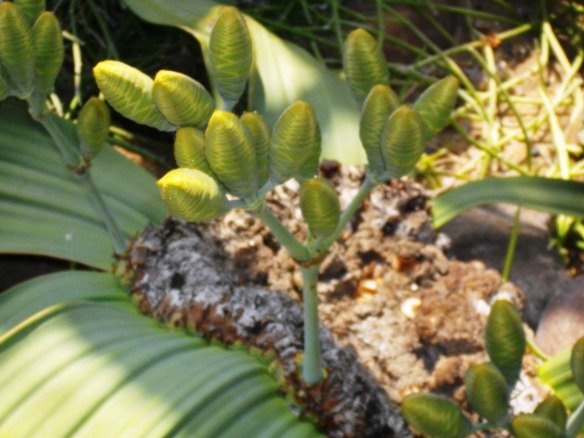
Welwitschia mirabilis female cones green and yellow
Author: Ivan Lätti
Photographer: Ivan Lätti
The female reproductive cones of Welwitschia mirabilis shown here were photographed in the greenhouse at the Botanical Garden of the University of Stellenbosch. As the plant is dioecious this specimen does not produce male cones.
The female cones contain the pistillate flowers consisting of a tubular perianth and an exposed ovule. They are yellow green or blue green, sometimes with red-brown stripes. Stout, larger, and more robust than the male cones, each scale contains an ovule with an exposed stigma receptive to pollen. The female cone dimensions are about 8 cm long and 4 cm wide.
They are probably pollinated by wasps and bees that visit both male and female cones growing near enough to each other and are ready at the same time, for pollen transfer and the concomitant small amounts of nectar distributed as reward.
These female cones mature in spring with viable seeds, about nine months after fertilization (Mannheimer and Curtis, (Eds.), 2009; iNaturalist; Wikipedia; https://pza.sanbi.org).