
Albums
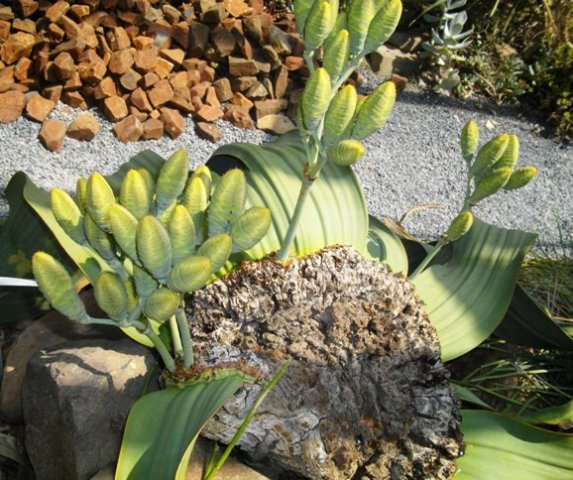
Welwitschia mirabilis flattened top of the stem
Author: Ivan Lätti
Photographer: Ivan Lätti
The stalks of the female cones of Welwitschia mirabilis emerge from the edge of the inverted conic structure, the flat to undulating, dry top of the central, obconical stem of the plant. It is short, woody, and fibrous, resembling a distorted stump. The stem top meristem dies in the centre, the new growth continuing only around the periphery, the edges of the crown. This is similar to the wood of tree trunks where new vascular and cork cambiums are formed on the outside as observed in year rings.
The stem is above-ground or partly so, but also growing underground, usually from 30 cm to 50 cm tall. In some large specimens the stem can exceed 1 m in height and diameter, the widest point of the plant's central cone, as the living edge continues to grow upwards and outwards. The sides of the cone usually grow unequally, causing the plant to become increasingly distorted as it ages.
The growth of the stem starts between the two cotyledonary buds of the plant’s beginning. The two normal, life-long leaves grow opposite the elongated cotyledons. Below the stem the plant's roots extend downwards, the taproot as far as 30 m. Most fine roots and major lateral roots are concentrated in the upper 10 cm to 60 cm of soil, where fog and dew moisture accumulate and can penetrate (Mannheimer and Curtis, (Eds.), 2009; iNaturalist; Wikipedia; www.namibweb.com; https://pza.sanbi.org; https://the-eis.com).