
Albums
Butterfly occurring most widespread on earth?
Author: Ivan Lätti
Photographer: Uri Mitrani
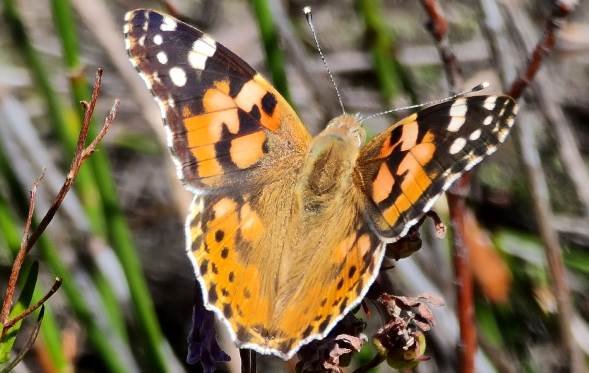
Vanessa cardui, commonly called the painted lady butterfly or just painted lady, and previously scientifically Cynthia cardui, is thought to be the most widespread of all butterfly species on earth. In North America it is known as the cosmopolitan. It is found on all continents excepting Antarctica and South America.
Multi-coloured in orange, brown, black and white, with olive and ochre overtones on wings and body, it has a 4,5 cm wingspan. In South Africa its spiny, black larvae feed on many plants, mainly of the Asteraceae family, genera like Arctotis, Berkheya and Gazania.
Butterflies are secondary to bees as pollinators. Their ecological importance lies in the diversity of particularly woodland and wildflower plants they service, the distances they travel, and their tendency to pollinate flowers that bees may ignore. The general contribution of butterflies lies in transferring pollen, done inadvertently as they feed on nectar. Bees are more deliberate as pollen collectors. Butterflies are considered important in agriculture, for instance relating to the pollination of cotton plants.
The painted lady butterfly is common in most habitats, significant in drier areas (Curtis-Scott, et al, 2020; iNaturalist; https://blog.entomologist.net; https://www.gbif.org; https://www.insectlore.com).