
|
Botanical name |
Aloe broomii |
|
Other names |
Snake aloe; slangaalwyn (Afrikaans) |
|
Family |
Asphodelaceae |
|
Dimensions |
Usually a single-stem aloe, but may divide into two or three rosettes; may be 1,5 m tall; usually a well developed rosette of up to a meter wide |
|
Description of stem |
Appears squat with the persisting old, dead leaves to ground level |
|
Description of leaves |
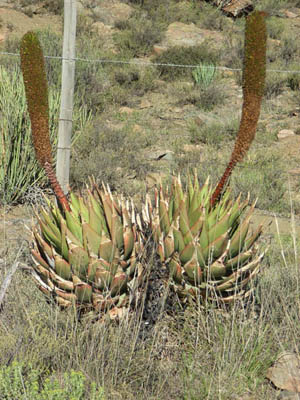
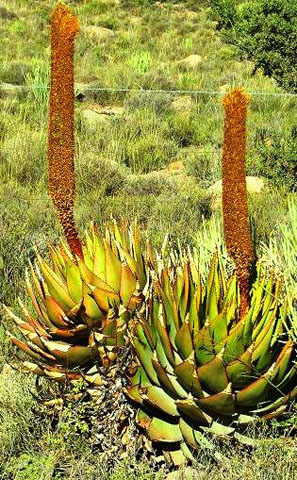
Light green, occasionally darker green; the distinctively longitudinally lined leaves are densely packed in a compact, somewhat bulky rosette; the edges are reddish and armed with sturdy, sharp teeth; a keel row of spines partly up the outer surface, or sometimes a few scattered spines |
|
Description of flowers |
Single, long, snakelike racemes of up to 1,5 m have densely packed flowers, of which the excerted stamens are the prominently visible parts among the enclosing bracts; the perianth is yellow but hidden behind the other flower parts |
|
Desciption of seed/fruit |
|
|
Description of roots |
|
|
Variation |
|
|
Propagation and cultivation |
This aloe transplants readily and grows in cultivation in well-drained soil in full sun |
|
Tolerances |
Thrives in hot summer conditions, also adapted to cold winters, even including snow |
|
Uses |
Garden plant, although a less common one |
|
Ecological rarity |
Not threatened |
|
Pests and diseases |
|
|
Other |
|
|
Location |
Dry north facing slopes among grass and low bushes, in rocky and mountainous areas |
|
Distribution (SA provinces) |
Eastern and Northern Cape, Free State |
|
Country |
South Africa |