

Virgilia divaricata
Author: Ivan Lätti
Photographer: Thabo Maphisa
Virgilia divaricata, commonly the pink keurboom, is one of the two popular keurboom species endemic to South Africa (SA Tree List No. 221.1). The rounded growth habit of V. divaricata sometimes reaches 10 m in height.
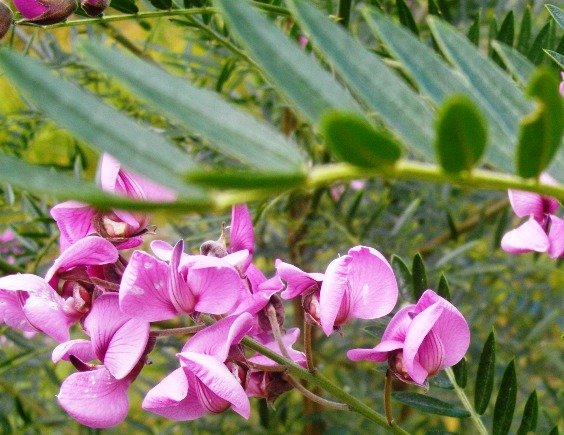
The compound leaves comprise seven to nine pairs of leaflets as well as a terminal leaflet, the structure referred to as imparipinnate.
The flowers are similarly shaped as peaflowers, violet, dark or pale pink to white, growing in short sprays at stem-tips late winter to early spring or during early autumn. The often violet-pink flowers have dark purple tips on their keels as in the photo.
The distribution range of V. divaricata is coastal in the east of the Western Cape from around Mossel Bay and in the Eastern Cape as far east as Makhanda.
The habitat is forest margins and riverine fynbos valleys. The habitat population is deemed of least concern early in the twenty first century.
The equally admired relative is V. oroboides, the two trees sometimes mixed up. The main points of difference on the leaves are greener, and less hairy leaves on V. divaricata, mainly on the lower surfaces. To make matters more interesting, V. oroboides also has two subspecies, viz. subsp. oroboides and subsp. ferruginea, both found in the Western Cape only.
Both trees are popular in gardens and parks although they do not live much longer than 20 years (Coates Palgrave, 2002; Van Wyk and Van Wyk, 1997; iNaturalist; https://pza.sanbi.org; http://redlist.sanbi.org).