

Lithops olivacea leaves
Author: Ivan Lätti
Photographer: Judd Kirkel Welwitch
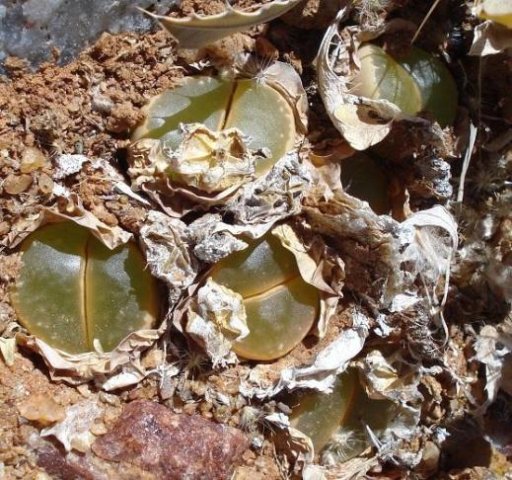
The leaf pairs of the branched Lithops olivacea plant in picture are well sunk in the ground, showing little or no lateral leaf body surface parts protruding above-ground.
The translucent windows on top of the leaf bodies may also be blue-green, green, grey or brown in this species. Here they live up to their specific name of olivacea, being olive green. The plant in picture has very few of the pale, opaque islands sometimes more prevalent in leaf body windows. The leaf body upper surface measurements are about 18 mm by 15 mm.
Should the two varieties of this species have still been recognised, the plant in picture would have been called var. olivacea, as the leaves of each pair cohere closely; in var. nebrownii they diverge.
The pale, papery material lying around the live leaves in picture are the discarded coats worn for a period by the leaves. These coats constitute the skins of last year’s desiccated leaves, persisting to provide young leaf body cover against the elements (Frandsen, 2017; Van Jaarsveld, et al, 2006; Smith, et al, 1998; iNaturalist; https://llifle.com; https://pza.sanbi.org).