

Nelia pillansii leaves
Author: Ivan Lätti
Photographer: Judd Kirkel Welwitch
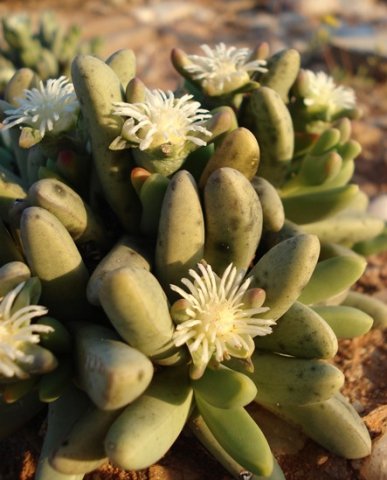
The opposite, succulent leaves of Nelia pillansii are erect and finger-like, between three-angled and cylindrical. The keels are rounded as are the tips. The smooth leaf surfaces are pale green or grey green. Dark patches tend to proliferate on older leaves.
There is a thick, crystal layer inside the outer walls of the leaves. These microscopic crystals called raphides or druses reside in leaf tissue, especially in the layers near the surface. Common in many succulents, they serve several protective and physiological purposes.
There are stomata on the leaves, tiny pores for gas exchange, beneath slightly raised “helper” cells called subsidiary cells (Frandsen, 2017; Le Roux, et al, 2005; iNaturalist; https://www.academia.edu).