

Psychotria capensis subsp. capensis leaves
Author: Ivan Lätti
Photographer: Francelle van Zyl
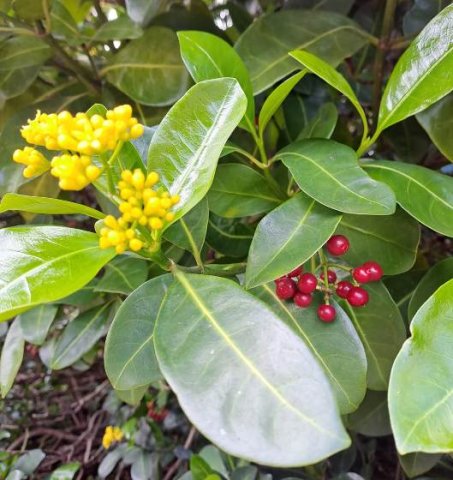
Psychotria capensis subsp. capensis new leaves are brighter green and glossier than their older counterparts. The stalked, opposite leaves are obovate to elliptic. Leaf size varies considerably, the dimensions from 3 cm to 20 cm long and from 1 cm to 10 cm wide. The leaves taper to blunt, obtuse tips or are rounded, their bases tapering. The leaf margins are entire.
The mature blades tend to be leathery, and darker when the tree grows in a forest rather than in the open. The midrib and four to six pairs of lateral veins are visible, prominent on the lower surfaces where domatia or pits may be present in the junctures of the lateral veins to the midrib. The early leaf stage differs in the photo, midribs and lateral veins bulging on top but not for long.
The domatia referred to are small chambers on the plant, inhabited by arthropods like mites and ants. As vacuums in nature tend to be filled, domatia are natural housing schemes that somehow acquire inhabitants without trying, just being available. This is similar to early man being attracted to available caves (Coates Palgrave, 2002; Schmidt, et al, 2002; Van Wyk and Van Wyk, 1997; Pooley, 1993; iNaturalist).