
Salvia lanceolata
Author: Ivan Lätti
Photographer: Francelle van Zyl
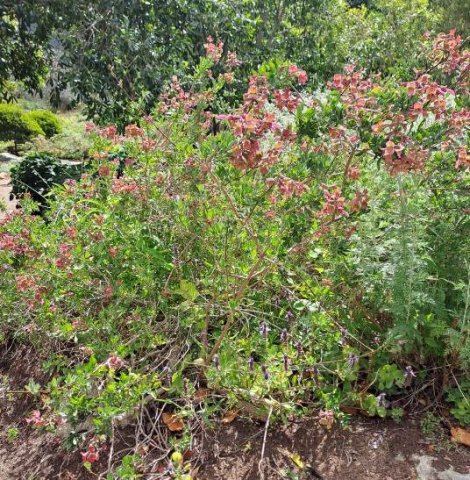
Salvia lanceolata, commonly known as the rusty sage or the lanceleaf sage and in Afrikaans the strandsalie (beach salvia), sandsalie (sand salvia) or rooisalie (red salvia), is a much-branched shrub reaching 80 cm to 2 m in height. It is often as wide as it is tall, the lower stems becoming woody. The erect plant grows quickly and is aromatic.
The species distribution is in the Western Cape from the Cape Peninsula eastwards to Caledon and northwards to the Knersvlakte and further in Namaqualand to the southwest of the Northern Cape, as far as Springbok.
The habitat is fynbos and scrubveld on flats, lower slopes in sour sandy soil, on limestone and rocky outcrops. The habitat population is deemed of least concern early in the twenty first century.
The plant is unpalatable, not much browsed. It is a drought tolerant garden plant. This Salvia is not used in traditional medicine, or used as much as some of the other species of the genus (Manning, 2009; Le Roux, et al, 2005; Leistner, (Ed.), 2000; Manning and Goldblatt, 1996; Bond and Goldblatt, 1984; iNaturalist; https://pza.sanbi.org; http://redlist.sanbi.org).