
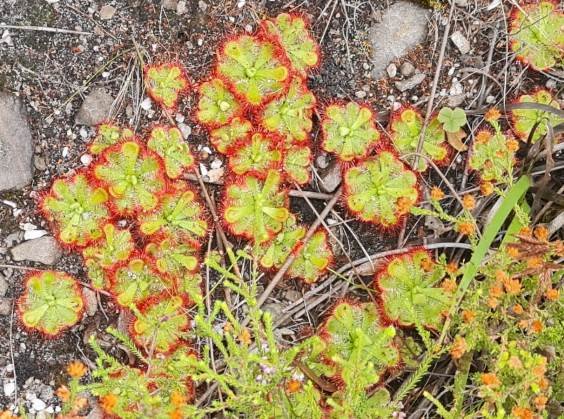
Drosera aliciae colony
Author: Ivan Lätti
Photographer: Uri Mitrani
A stand of Drosera aliciae leaf rosettes, big and small, readily proliferates when the moist soil conditions persist and many insects visit to be eaten. The yellow-green leaves bear their red haloes of glandular hairs around and near the leaf tip perimeters.
Propagation of new leaf rosettes may happen from seed. That is what flowers are for. Vegetative growth also brings new leaf rosettes, directly from the roots of existing plants, clones around parent plants. Even the small rosettes in picture already have fully formed, adult‑shaped leaves, the juvenile stages of growing from seed having been skipped here. Had they grown from seeds, the beginnings would have shown some cases of the tiny, spatulate cotyledons of seedlings, followed by miniature juvenile leaves.
Grown from seeds, the gene pool is enriched. Vegetative growth ensures more rosettes of the same genetic material as the parents, their seeds more children of the same parents (Euston-Brown and Kruger, 2023; Manning, 2007; Bean and Johns, 2005; iNaturalist; Wikipedia).