
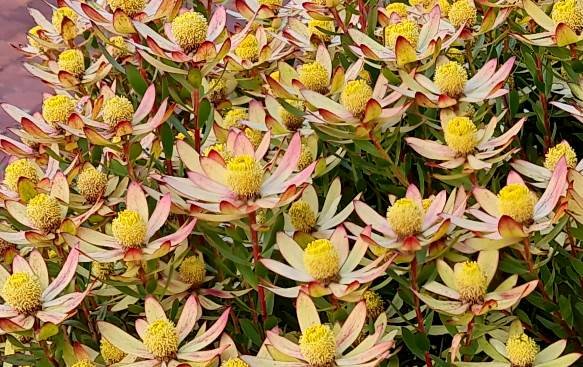
Leucadendron gandogeri ample pollen cones
Author: Ivan Lätti
Photographer: Uri Mitrani
The creamy yellow, male Leucadendron gandogeri flowerheads grow solitary and sessile at many stem-tips of the rounded male plants. These stubby pollen cones are nearly cylindrical to barrel-shaped from ripe pollen available on open floret pollen presenters protruding on the fluffy sides of the heads.
Their bloomtime coincides with that of the fruit cones on the female bushes of their species. This is a requirement for the sunbirds, some other feathered friends, as well as bees and butterflies to upload and drop off the pollen successfully. The pollen grains on insect and bird bodies received at male bushes ending up on female floret stigmas of cones at stem-tips of suitably close female bushes is clearly a percentage game. The success rate is so far sufficient for survival of the flowering species. The process allows enough seeds to germinate, keeping the species numbers stable in nature.
Not doing the sums of required numbers before growing, the bushes supply as much as they’re capable of. This is the same strategy that people would follow in their position, should they be incapable of the maths involved. Surpluses serve as food for many species, and as organic material functional in soil formation (Manning, 2007; Bean and Johns, 2005; Rebelo, 1995; iNaturalist).