
Protea compacta erect staminodes
Author: Ivan Lätti
Photographer: Uri Mitrani
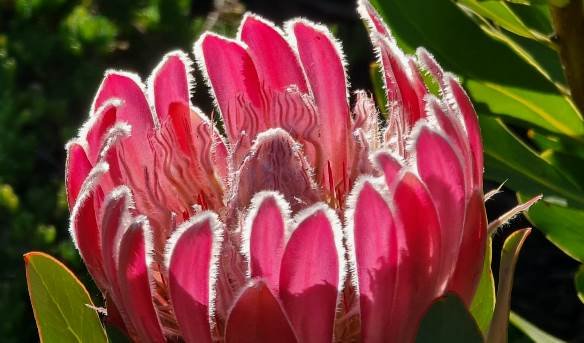
This flowerhead of Protea compacta shows the densely ciliate or hair-fringed margins of their tallest, innermost ring of involucral bracts. These bracts curve their tips in slightly, over or towards the florets they once protected. In the centre of the head there is a compact cone of floret tips not yet open, waiting their turn. Between the ring of bracts and the cone there is a gap where the already open flowers, the earliest openers, are positioned.
In many Protea species it is only the styles tipped with pollen presenters that stand tall once the florets are open, e.g. in pincushions. In others, like proteas, the bracts form an outer ring around the freed styles. The discarded floret parts that covered the styles or perianth segments fall back, lying in a heap around the style bases. The opened pollen presenters start off covered in the pollen of their own florets, smeared there when the floret or perianth opened, as the four segments dropped away. After pollen has thus been delivered onto the pollen presenter, it waits for pollinators to fetch the pollen grains and transport them to older florets elsewhere, ready to be fertilised. That is the usual way in which florets in Protea family flowerheads start off.
Later, when the florets' own pollen grains are gone, used elsewhere, the pollen presenters change roles. Then they become stigmas, assuming their female functions of pollen receivers. By this time, ready for new action, they are still erect and sticky, receiving pollen from other florets landed by insects, birds or small mammals that visit florets for their own needs. The pollinators come here to eat pollen and drink nectar, their reciprocal contribution of pollination of no concern to them. As they visit floret after floret, pollen grains land on their bodies. Some get discarded serendipitously on other florets, unnoticed by the the transporters. The right pollen grain landed, one from another floret of the Protea's own species, the growing down the style to fertilise the ovule happens.
The photo shows that in P. compacta there is more. Two different types of floret parts remain erect, easily distinguishable. Firstly, there are the expected straight styles with pollen presenters at the top, the conventional ones doing the conventional task, common throughout the range of Proteaceae flowerheads. Secondly, what is also present and erect here, and not common in many kinds of Protea flowerheads, are staminodes or stamens without anthers, bearing no pollen. These ones were initially the outer perianth segments of the florets in bud. They did not have anthers at their tips, and remain erect upon floret opening.
These outer (or abaxial) fourth segments of the P. compacta florets, the pollenless staminodes, can be spotted in the photo: They are the kinky, curved ones resembling contortionist dancers who seem here to have found many like-minded partners in the open-space ring part of the head. The other three pollen-delivering anther segments of the opened florets have collapsed as usual when their jobs were done.
The fourth segment, the outer one, was never burdened by a load to deliver. Not all proteas are built like this. P. compacta is one of the few species with the atypical perianth segments that do not bear pollen. These staminodes remain erect, as if observers of subsequent proceedings. What could the purpose of that be? And why the zigzagged shape? Check the squiggle-heads out in the photo!
The only worrying thing in this story is that there are, or appear to be, too many of these would-be staminodes, not equal to the number of free styles seen in the head, one segment left standing per style. Could more than one perianth segments of open flowers, proper stamens, have remained erect? Or are some segments freed prematurely from still-to-open florets in the central cone of floret buds? Do the segments for some reason break apart longitudinally in maintaining their unusual posture or because of it? Or become thinner when perianths split? Might some styles develop zigzags?
A few other Protea species also have staminodes in their abaxial perianth segments. P. repens, P. longifolia and P. neriifolia are known for this. P. neriifolia may have some staminodes remaining erect for some period after floret opening. Only P. compacta has such a strong showing of this unusual phenomenon (Rourke, 1980; iNaturalist; with assistance from AI tools (Copilot)).