
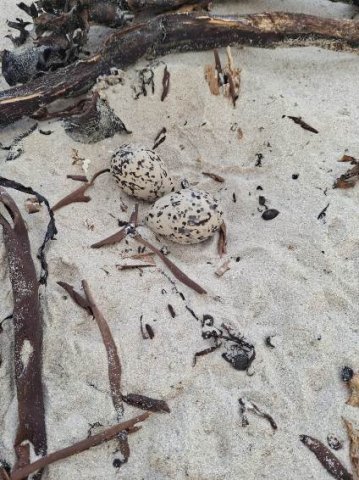
African black oystercatcher eggs
Author: Ivan Lätti
Photographer: Francelle van Zyl
Exposed on bare sand like this, the eggs of the African black oystercatchers, a clutch of one to three but mostly two, constitute the main survival risk of the species. These eggs are a buff stone colour in different shades, or sometimes greenish, as well as spotted or variably marked in blackish brown and purplish grey. Egg dimensions are about 6,5 cm long and 4,1 cm wide. The simple hollow scraped in beach sand or among pebbles is mostly within 30 metres of the high-water mark. This is also the first home of the newly hatched chicks.
Risk escalated in the past from beachgoers, off-road vehicles, children and dogs. Even when not physically disturbed or damaged, the eggs may overheat if hatching birds are forced to move away for long. Chicks may also die from starvation. Breeding success is greater on offshore islands where the predators and human disturbances are fewer.
Awareness of the plight of these birds along the South African coast has increased in recent years, people taking more care not to invade the space of breeding pairs and keeping away from eggs or chicks. In nature some bird species, including certain gulls, and also snakes eat the eggs and the chicks. Adult oystercatchers are not as much at risk in their coastal living space.
Both parents share the incubation duties which last from 27 to 39 days. Then follows another about 40 days of caring for the fledglings, the situation gradually becoming less precarious as young birds reach independence, finding their own food and fending for themselves. The breeding season is from late spring to mid-autumn (Maclean, 1993; iNaturalist; Wikipedia).