Fit for survival?
Author: Ivan Lätti
Photographer: Uri Mitrani
Human population numbers and activities swamp the earth’s habitable parts to the detriment of other species. As people take up space, bigger animal species are either food for people, or their numbers reduced to fit into faraway places or shrinking nature reserves. Their food webs and undisturbed existence in natural habitats are being eroded, and now there is climate change. The global village is putting paid to many faraway places good for animals.
Smaller bodied animals like mice and lizards may still maintain unaffected larger populations in some places far from people. Birds and those insects that leave people, their houses and their food alone, have a brighter future in population number terms. The principle extends to pets scaling down in size and number. The exceptions are for the affluent that can afford more space, the poor that live on low-priced land, or the insensitive that keep too big animals in too tiny quarters. The message: If you’re a small animal, you are welcome to breed, as long as your offspring don’t bother the people.
If this weird talk of exclusive land use and dominating the biosphere is already true or getting there, we have to think about the implications for life on earth. As humanity’s numbers, infrastructure, agriculture, and resource use have reshaped ecosystems on a planetary scale, the residual living space for “all the rest” needs consideration.
Are we saying the small, generalist species adapted in marginal habitats where humans don’t compete are the ones to keep? Should the rest be relegated to zoos and eventually picture books, archives or video recordings? Every human generation gets used to less space for itself, and for its “islands” of nature reserves. Many of these "islands" shrink without the shrinking being noticed, becoming too small for supporting the numbers of a few years ago. Or can food production per hectare be increased, urban housing become more high-rise to sustain more biodiversity until human numbers stop growing?
Turning the question to birds, vultures are under threat from poison and famine, raptors from power generation and distribution, penguins and others from oil spills, while several kinds are sucked into jet engines. More species join the endangered list as cities expand and technologies diversify. The threats are uneven and selective among the kinds of birds: It is the large-bodied, slow-breeding, habitat specialist species, as well as those dependent on intact ecosystems that are going faster.
The currently reprieved types are the generalists, the adaptable species that fit into multiple environments, e.g. the coastal ones that feed on beaches, landfills, fishing harbours, and agricultural fields… until there is human retaliation. The mobile ones that shift location rapidly when conditions change, and those able to exploit human food sources do well… until there is human retaliation.
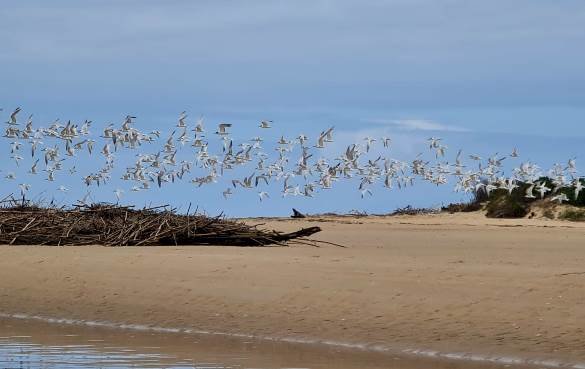
An agile, opportunistic flock of smallish coastal birds like the one in the photo can today still be seen, even comprising large numbers, because the uncontested habitat still provides food like fish, invertebrates, and human scraps all sorts. These birds are not easily displaced by the human presence. Their mobility gives them resilience, and they get away with being cheeky.
The biodiversity of the Anthropocene, the geological epoch of significant impact by human activity, is being transformed. Life on earth keeps changing as ever before, never reverting to any of the good old days. This is (so far) not happening as abruptly as the mass extinction of the non-flying dinosaurs around 66 million years ago. With them went the bigger other animals of their time, those weighing more than 25 kg, but excluding the sea turtles and crocodilians. Size was a drawback then, as it is today if you get in humanity's way. So far.
Birds are all descendants of dinosaurs, from a branch of small, ground‑dwelling, beaked theropods. Some of them, maybe those flying in the photo, may again survive traumatic challenges, leave behind whatever is taken by the next extinction, possibly humanity as well.
Worth thinking about? Can we do anything about this? What will the costs be? Could the result be worth the effort? Does the "somebody else" designated to take responsibility for such work belong to our species? Time to scroll to the next story? (Wikipedia)