
Virgilia
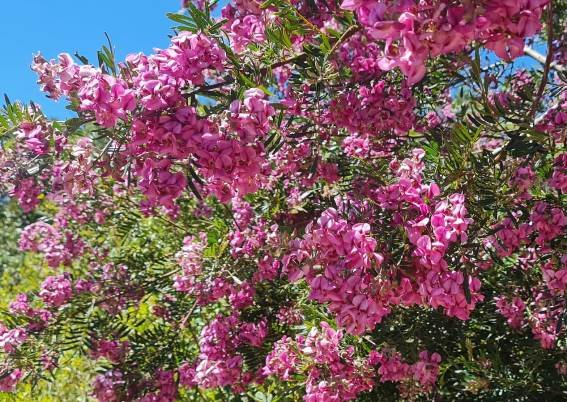
Author: Ivan Lätti
Photographer: Uri Mitrani
Virgilia is a genus of small to medium-sized trees in the Fabaceae or pea family. The tree is commonly known as the keurboom or blossom tree. The bark is smooth to coarse. The crowns are narrow or spreading.
The compound, alternate leaves are imparipinnate, meaning that a terminal leaflet is present. The variable leaves comprise mostly six to twelve pairs of leaflets, although many more, or far fewer are also seen. The leaflets are nearly stalkless, the leaf-shape elliptic, lanceolate, ovate or linear. Short mucros are present at the leaflet tips that may also be notched. Narrow stipules grow at the petiole bases. The leaflet midribs are sunken on the upper surfaces. The leaflet blades are hairy in white or brown, or mature leaves may be hairless, sometimes glossy.
The flowers grow in racemes from leaf axils and near stem-tips, occasionally in panicles. The bracts are small, falling early. The hairy calyces are two-lipped with toothed margins, their tubes basin-shaped. The corollas resemble those of peaflowers. Flower colour is pink in several shades, white, rose-violet or magenta. The banner petals are nearly round to obovate and strongly reflexed. The wing petals are sickle-shaped with clawed bases. The keels are incurved and beaked, shorter than the wings that flank them.
There are ten free stamens in a flower with linear filaments in a tight tube around the style, the anthers small. The hairy ovaries have short stalks. Their styles are curved and the stigmas small.
The leathery or woody fruit pods have two valves each. They are linear or oblong, brown and dehisce when ripe. The yellow brown, dark brown or black seeds are elliptic and flattened.
The only two Virgilia species are endemic to South Africa, occurring coastally in fynbos river valleys and forest margins of the Western Cape and the Eastern Cape.
The trees are often pioneers. Their seeds germinate much after fire, and the plants improve the soil due to fast biomass production and nitrogen fixation. The stems and trunks are often infested by the larvae of the silver spotted ghost moth, in Afrikaans keurmot (virgilia moth), and scientifically Leto venus, a kind of woodborer. The prolific germination of the seeds after fire is countered, balanced, by these large, pretty moths, allowing other, slower species to gain ground.
Keurboom’s River near Plettenberg Bay is named after Virgilia trees. They are popular as ornamental trees in gardens and parks, although short-lived. Germination is easy and the saplings grow fast, mature tree sometimes seen after four years.
The wood is soft, yellow brown and light. It was generally used in the past, the days when ox wagons needed many parts, but suitable logs are not often found these days (Leistner, (Ed.), 2000; Venter, 2012; Manning, 2007; Coates Palgrave, 2002; Van Wyk and Van Wyk, 1997; iNaturalist).