
Wachendorfia
Author: Ivan Lätti
Photographer: Wikus Riekert
Wachendorfia is a genus of rhizomatous perennials in the Haemodoraceae or bloodroot family. In search of the origin of the name: haima is Greek for blood and dôran means gift. Plant size ranges from 10 cm to 2,5 m when in flower. The tuberous rootstock in a papery tunic is cylindrical to ovate, containing red cell sap. Leaf bases form a kind of tunic around an old rhizome. Some of the plants are evergreen, others deciduous.
The leaves grow from stem bases where they are sheathed. The two-ranked leaf arrangement forms a loose fan, the leaves oriented with one margin facing the stem. The leaves are lance-shaped, linear or sickle-shaped. The blades are longitudinally pleated or corrugated, the blades of some species hairy.
The flowers grow in cylindrical or open panicles. A flower consists of six tepals arranged in two concentric whorls of three, the corolla shape slightly irregular. The outer three tepals are firmer and hairy on the outside. The inner three are united at the base and sometimes obscurely spurred. Flower colour is yellow, apricot and sometimes brownish in parts. The upper three tepals often have dark to light nectar guide markings at the base, as if two-lipped. Individual flowers last for about one day.
The three similar stamens grow opposite the inner tepals, the filaments thread-like. The stamens turn sideways, two to one side, the third in the opposite direction. The style twists in the direction of the single stamen. The phenomenon of enantiostyly means that the style is deflected asymmetrically to the left or right of the floral axis. The twisting adheres consistently to the same pattern on a particular plant. The hairy ovary is superior, the petals and stamens emerging from below it. The stigma is small and head-like. Only one ovule is present in each of the ovary’s three locules.
The fruit capsule is acutely three-angled, wider than high. When ripe, the locules dehisce independently along midrib sutures, freeing the globose, hairy seeds.
There are four Wachendorfia species, all found in the fynbos of the Western Cape and the Eastern Cape, almost always in the winter rainfall region.
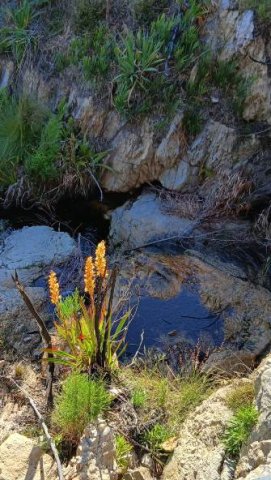
The yellow-flowering plant in picture is Wachendorfia thyrsiflora growing by water as it often does (Leistner, (Ed.), 2000; Manning, 2009; iNaturalist; Wikipedia).